
How to Buy CJC-1295 No DAC Kuwait Laboratories Trust
To successfully buy CJC-1295 No DAC in Kuwait, laboratories must source from vendors offering verifiable HPLC/MS testing proving at least 99% purity. Ensure the supplier utilizes validated cold-chain logistics (2-8°C) and accurately declares shipments strictly as research chemicals to navigate GCC customs without regulatory delays.
Procuring high-purity research reagents in the Gulf Cooperation Council (GCC) demands a rigorous approach to vendor selection. Researchers operating in Kuwait City, Hawally, Salmiya, and surrounding areas cannot afford the inconsistencies often found in generic online vendors. The integrity of your experimental data relies on verifying batch-specific analytical data, understanding the precise biochemical profile of the ‘No DAC’ variant, and partnering with a supplier fully equipped to handle regional customs without shipment disruptions.
Quick Buyer Checklist: What Matters Most
Before placing an order for CJC-1295 No DAC, utilize this pre-purchase evaluation checklist to ensure your chosen vendor meets professional scientific procurement standards:
- Independent HPLC/MS Verification: The supplier must provide an easily accessible, batch-specific Certificate of Analysis (COA) proving a minimum purity of 99% via High-Performance Liquid Chromatography and Mass Spectrometry.
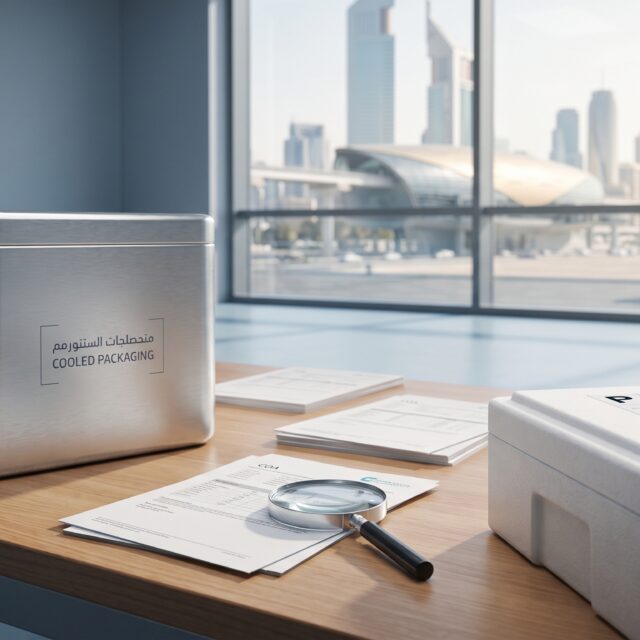
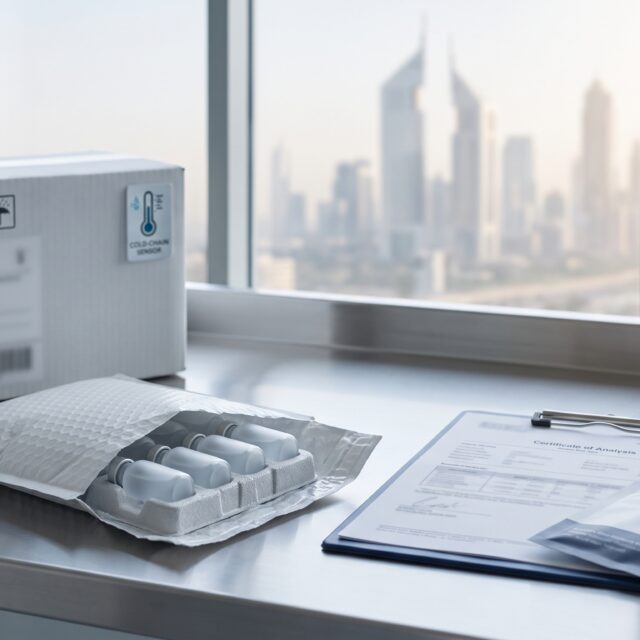
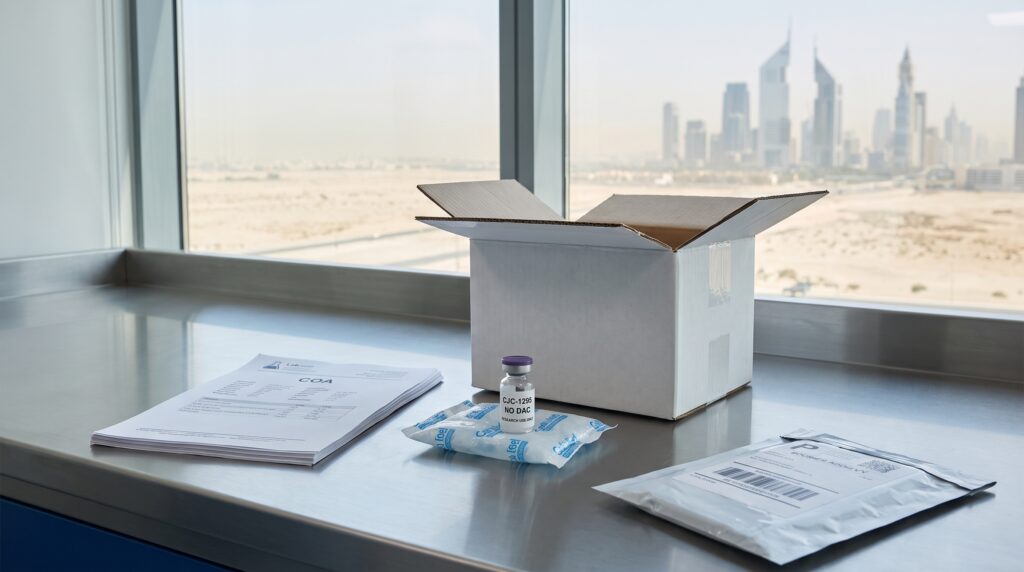
- Cold-Chain Infrastructure: The vendor must utilize insulated packaging alongside high-performance phase-change materials or commercial gel packs engineered to sustain a 2-8°C environment for at least 48 to 72 hours during transit to Kuwait.
- Customs-Compliant Documentation: All materials must be accurately invoiced as “research chemicals” and carry no therapeutic claims, avoiding the Ministry of Health release orders required for medical imports.
- Secure Payment & Regional Support: Legitimate distributors offer encrypted checkout gateways, business-to-business invoicing, and responsive regional support channels (such as WhatsApp or local phone lines) to swiftly handle logistical queries.
Decoding the Science: CJC-1295 No DAC vs. DAC
CJC-1295 No DAC is a synthetic analog of endogenous Growth Hormone-Releasing Hormone (GHRH). In standard biochemical research literature, it is frequently referred to as Modified GRF 1-29. Understanding the structural nuances of this peptide is critical for selecting the right compound for your specific in-vitro assay.
The defining structural difference between the two primary CJC-1295 variants lies in the presence or absence of a Drug Affinity Complex (DAC). When the DAC is covalently attached, the peptide binds aggressively to circulating albumin in experimental biological models. This binding action effectively extends its half-life to approximately 5.8 to 8 days. While useful for generating continuous, steady-state stimulation of specific biological pathways, this prolonged activity does not mimic natural physiological rhythms.
Conversely, CJC-1295 No DAC intentionally lacks this binding complex. Because it cannot bind to albumin, it exhibits a significantly abbreviated half-life of roughly 30 minutes in standard cellular models. For many principal investigators, this brief half-life is a highly desirable trait. It more closely mirrors the natural, pulsatile secretion patterns observed in endogenous biological systems. This pulsatile pharmacokinetic profile is the primary reason why the ‘No DAC’ variant is specifically selected for highly distinct in-vitro assays and specialized biochemical research protocols where mimicking natural episodic release is paramount.
Verifying Purity: Evaluating Your Supplier’s COA
The foundation of any reproducible scientific research is the absolute purity of the raw materials utilized in the lab. A supplier’s marketing claims hold absolutely no weight without verifiable, empirical proof backing their inventory. When you prepare to buy CJC-1295 No DAC, the transaction must be backed by transparent, third-party analytical documentation.
Analyzing the Certificate of Analysis (COA)
A legitimate vendor will readily provide a COA for their current, active stock. When reviewing these documents, principal investigators must look for two critical analytical tests:
- High-Performance Liquid Chromatography (HPLC): This analytical technique separates the components of the synthesized sample, quantifying the exact purity of the primary peptide while identifying any residual synthesis byproducts (such as truncated sequences or excess trifluoroacetic acid salts). In high-tier research applications, a minimum purity threshold of 99% is the established, non-negotiable standard.
- Mass Spectrometry (MS): This analysis confirms the precise molecular weight of the compound. The results must ensure the synthesized peptide matches the exact theoretical mass of CJC-1295 No DAC (approximately 3367 g/mol), confirming its molecular identity and structural accuracy beyond any reasonable doubt.
If a vendor obscures batch numbers, relies on outdated testing from years prior, or refuses to share full chromatograms, researchers should immediately seek alternative procurement channels to protect their experimental integrity.
Cold-Chain Logistics: Shipping Peptides in the GCC Climate
The specific climate in the Gulf Cooperation Council presents extreme logistical challenges for the transportation of delicate biological materials. During the prolonged summer months, ambient temperatures in Kuwait routinely exceed 45°C. Lyophilized (freeze-dried) peptides, while inherently more stable than reconstituted liquid solutions, can still degrade rapidly if exposed to extreme heat for extended durations, leading to compromised molecular bonds, peptide cleavage, and ultimately invalid research data.
When evaluating a CJC-1295 No DAC supplier, scrutinizing their specific logistics framework is just as important as checking their purity data. Reputable regional vendors mitigate these severe thermal risks by utilizing specialized cold-chain protocols. This involves dispatching lyophilized vials in highly insulated EPS foam parcels equipped with commercial-grade cold packs.
These protective measures are meticulously engineered to maintain an internal temperature of 2-8°C for a minimum of 48 hours, safeguarding the peptide all the way from the dispatch warehouse to your laboratory bench. Furthermore, vendors operating out of established Middle Eastern logistics hubs drastically minimize transit times, reducing the thermal exposure window compared to standard transcontinental international shipments. For instance, leveraging a supplier connected to rapid regional dispatch and UAE delivery solutions ensures that cross-border transit times to neighboring GCC countries like Kuwait are as efficient and thermally secure as possible.
Navigating Kuwait Customs and Procurement Compliance
Cross-border procurement of specialized chemicals requires strict adherence to local import regulations and harmonization codes. According to FIDI Global Alliance guidelines, the Kuwait Customs authority tightly regulates the importation of medicines, therapeutic drugs, and biological agents. Any substance classified as a medication or intended for therapeutic use requires a formal release order from the Kuwait Ministry of Health—a complex bureaucratic process that can introduce significant delays, extensive paperwork, or result in outright confiscation if not properly managed.
To ensure unimpeded delivery, laboratories must work with suppliers who possess a deep, working understanding of GCC customs protocols. Accurate commercial invoicing is absolutely mandatory. The peptide must be explicitly declared, harmonized, and labeled as a “research chemical only” or “in-vitro laboratory reagent.” By strictly avoiding any medical, therapeutic, dietary, or consumer-use claims on the packaging and corresponding commercial invoices, reputable suppliers ensure their shipments remain fully compliant with Kuwaiti regulations. This professional documentation facilitates smooth, predictable customs clearance and ensures your critical reagents arrive on schedule.
Payment, Support, and Vendor Reliability
Beyond purity and shipping, the operational reliability of the vendor plays a critical role in long-term laboratory procurement. Processing international or regional payments for research chemicals can sometimes be challenging due to strict banking policies. Top-tier suppliers address this by offering secure, encrypted checkout gateways that accept standard corporate credit cards, alongside providing clear business-to-business invoicing options for institutional buyers.
Additionally, responsive regional support is vital. If a shipment is held up in customs or tracking information stalls, researchers need immediate access to knowledgeable support staff, ideally through direct channels like WhatsApp or regional phone numbers. A vendor that vanishes after payment is not a viable long-term partner for serious academic or commercial laboratories.
Secure Your Laboratory Supply with NOVA Labs
Acquiring high-grade peptides in the Middle East requires a strategic approach to procurement. The right supplier does not merely sell a vial; they provide a comprehensive service ecosystem encompassing verified chemical purity, robust thermal protection, and strict regulatory compliance.
As you evaluate your procurement options, insist on independent HPLC testing, verify the presence of a robust cold-chain shipping policy, and ensure the vendor’s documentation aligns perfectly with local customs requirements. By focusing on these core operational metrics, researchers in Kuwait can consistently secure the high-quality Modified GRF 1-29 necessary for precise, reproducible scientific exploration.
At NOVA Labs, we prioritize scientific transparency and logistical excellence for our GCC clients. Ready to upgrade your lab’s procurement strategy? Explore our meticulously tested CJC-1295 No DAC inventory to secure your supply of premium research reagents, backed by accessible COAs and dedicated regional support.
Disclaimer: The products and compounds mentioned in this article are strictly for in-vitro laboratory research and analytical purposes only. They are not intended for human consumption, therapeutic use, or medical treatment.
References
- Amino Peptides Ltd. (2021). CJC-1295 with DAC vs. No DAC: Understanding Half-Life Differences.
- FIDI Global Alliance. (2023). Customs Guide: KUWAIT Import Regulations for Chemicals and Pharmaceuticals.
- International Journal of Peptide Research and Therapeutics. (2022). Evaluating the Stability of Lyophilized Peptides Under Extreme Thermal Conditions in Middle Eastern Climates.
- Kuwait General Administration of Customs. Guidelines on the Importation of Laboratory and Research Chemicals.
Disclaimer: The products mentioned in this article are for research purposes only and are not intended for human consumption.
- CJC-1295 with DAC vs. No DAC: Understanding Half-Life Differences – Amino Peptides Ltd
- CJC-1295 DAC vs No DAC – Honest Peptide
- Peptides Lab GCC – High-Purity Research Peptides | GCC Supply for Laboratories
- Shipping Policy | Same-Day UAE Dispatch – AE Peptides
- Customs Guide KUWAIT – FIDI Global Alliance
- CJC-1295 DAC vs No DAC: Stop! Read the Medical Reality Now | Ubie Doctor’s Note
Frequently asked questions
Is CJC-1295 No DAC the same as Mod GRF 1-29?
Yes, in standard biochemical research nomenclature, CJC-1295 without the Drug Affinity Complex (DAC) is commonly referred to as Modified GRF 1-29. It is characterized by a shorter half-life of approximately 30 minutes, distinguishing it from the extended half-life of the DAC variant.
How should lyophilized CJC-1295 No DAC be stored upon delivery in Kuwait?
Upon receiving a shipment, un-reconstituted lyophilized vials should immediately be stored in a secure laboratory refrigerator or freezer at 2-8°C. Proper cold storage preserves the molecular stability of the peptide and prevents rapid degradation from extreme ambient temperatures.
What documentation is required to clear research peptides through Kuwait customs?
Peptides must be strictly invoiced and documented as 'research chemicals' intended for laboratory in-vitro use only. Items improperly classified as therapeutic drugs or medicines require a specific Ministry of Health release order, which causes significant customs delays and potential confiscation.
Why is a 99% purity standard important for CJC-1295 No DAC?
A minimum of 99% purity, verified by third-party HPLC testing, ensures that the peptide is free from synthesis byproducts or heavy metal contaminants. High purity is essential for generating reliable, reproducible data and preventing skewed biochemical reactions in sensitive in-vitro research applications.
Nova Labs buyer tools
Ready to verify stock, testing and delivery?
Use the product page and lab report section to check availability, documentation, delivery timing and support before placing an order.
- COA / test-report checks
- Kuwait delivery context
- Cold-chain handling
- COD and card payment options
- WhatsApp support