

Securing HPLC Tested Peptides GCC: Why Local Verification Matters
For scientific professionals and dedicated researchers operating in the Middle East, procuring high-quality biological compounds presents a unique set of challenges. When searching for reliable HPLC tested peptides GCC researchers must navigate a complex landscape of international customs friction, extreme regional temperatures, and varying degrees of vendor transparency. Relying on unverified claims or generic testing documentation is no longer sufficient in an era where research reproducibility depends entirely on compound purity.
Historically, buyers in the UAE, Saudi Arabia, and the broader Gulf Cooperation Council (GCC) had to source research materials from overseas. This meant accepting extended transit times, risking temperature degradation on airport tarmacs, and trusting supplier documentation that could not be independently verified locally. Today, the standard has shifted. Informed buyers demand rigorous third-party verification, batch-specific Certificates of Analysis (COAs), and localized logistics that protect the structural integrity of every vial.
Quick answer: To confidently verify HPLC tested peptides gcc, buyers must mandate independent Certificates of Analysis (COA) containing batch-specific chromatograms and LC-MS spectral data. High-quality GCC suppliers guarantee >99% purity and utilize local cold-chain logistics out of Dubai to prevent heat degradation during transit, avoiding international shipping risks.
Quick Buyer Checklist: What Matters Most
Before finalizing any procurement order, researchers should evaluate their supplier against a strict set of criteria. This checklist ensures you are receiving genuine, research-grade compounds rather than degraded or impure substitutes.
- Batch-Specific Documentation: Does the supplier provide a COA that matches the exact batch number on your vial? Generic or outdated COAs are a major red flag.
- HPLC Purity Above 99%: The chromatogram must demonstrate a single, distinct peak with an integration table confirming purity exceeding 99%.
- LC-MS Sequence Verification: High-Performance Liquid Chromatography proves purity, but Mass Spectrometry proves identity. Ensure both tests are present.
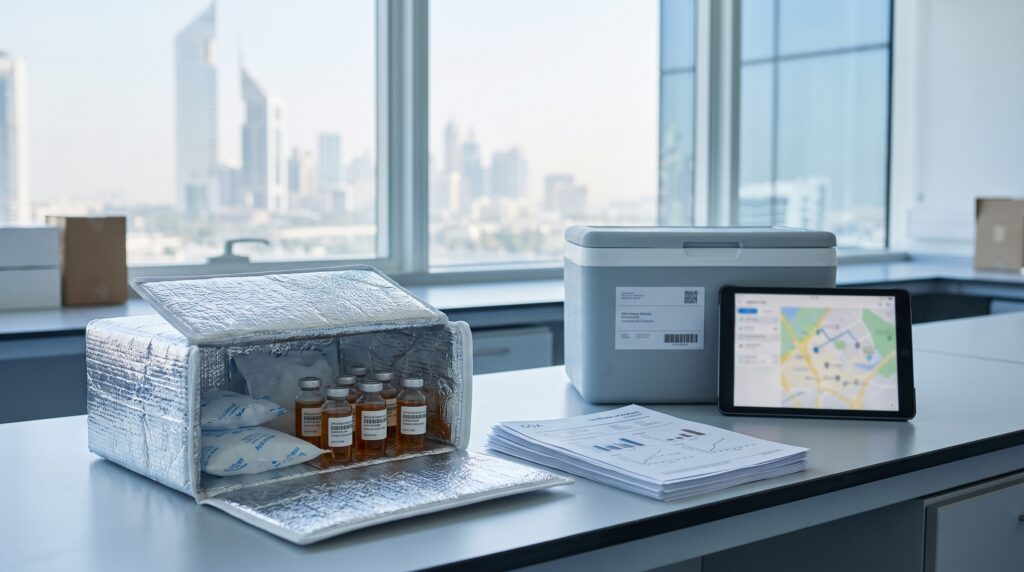
- Cold-Chain GCC Logistics: Does the vendor use insulated packaging? Temperatures in the UAE and KSA frequently exceed 40°C, requiring specialized handling to prevent rapid degradation of lyophilized compounds.
- Local Fulfillment & Support: Sourcing from a locally operating vendor minimizes transit times to 4-5 days across the GCC, drastically reducing the window for environmental damage.
How to Read a Peptide COA: HPLC and LC-MS Data Explained
Understanding the data behind your research materials is critical for laboratory success. The analytical gold standard for identifying and quantifying peptide purity relies on two tandem methodologies: HPLC and LC-MS.
High-Performance Liquid Chromatography (HPLC)
HPLC is utilized to separate a target compound from synthesis impurities. During the manufacturing process, unwanted byproducts such as truncated sequences or trifluoroacetic acid (TFA) salts can remain in the compound. An HPLC test pushes the dissolved peptide through a pressurized column, separating these elements based on their chemical properties.
When reviewing an HPLC test report, look at the chromatogram chart. You want to see a single, sharp, distinct peak indicating the primary compound. The accompanying integration data table will calculate the area under this peak as a percentage. For critical in-vitro research, this figure must be 99% or higher.
Liquid Chromatography-Mass Spectrometry (LC-MS)
While HPLC tells you how pure a substance is, it does not confirm the identity of the substance itself. This is where Mass Spectrometry becomes vital. LC-MS verifies the sequence, molecular weight, and structural integrity of the peptide.
The resulting mass spectrum will display peaks corresponding to the mass-to-charge ratio of the compound’s ions. The primary peak must align perfectly with the theoretical molecular weight of your specific peptide sequence. If a supplier cannot provide matching LC-MS data alongside their HPLC results, the fundamental identity of the compound remains unverified.
The Trust Gap in Peptide Research: Evaluating an HPLC Tested Peptides Supplier GCC
A structural issue within the research compound industry is the ‘COA gap’—the phenomenon where vendor-provided documentation does not accurately reflect the contents of the physical vial received. Some low-trust operators circulate manipulated documents, recycle old test results, or borrow COAs from other manufacturers entirely.
To bridge this gap, informed buyers must scrutinize their sources. Community blind testing and publicly accessible, searchable COA databases have become essential trust mechanisms. When evaluating an HPLC tested peptides supplier GCC, look for vendors who invest heavily in transparency.
At NOVA Labs, we recognize that research integrity cannot exist without absolute trust. That is why we maintain a rigorous standard of documentation, ensuring that researchers can access our comprehensive, searchable lab results database to verify the precise batch data for every compound in our catalogue.
Defeating Desert Heat: Cold-Chain Logistics for GCC Researchers
Beyond laboratory documentation, environmental logistics play a massive role in compound viability. The Middle Eastern climate is uniquely hostile to delicate biological structures. While properly lyophilized (freeze-dried) peptides possess a degree of stability at standard room temperatures, the extreme heat of the UAE and KSA summers—routinely exceeding 40°C to 45°C—poses a severe risk of degradation.
When international orders sit in unairconditioned customs warehouses or endure prolonged transit times (often 10 to 14 days), the peptide chains can break down, rendering the compound useless for precise laboratory applications. Local fulfillment fundamentally solves this problem.
By operating out of Dubai, a localized supplier can compress cross-border transit times to Saudi Arabia, Oman, Qatar, and Bahrain down to just 4-5 days. More importantly, reputable local operators utilize dedicated cold-chain logistics, insulated packaging, and strategic shipping windows to ensure that vials never sit exposed to extreme ambient temperatures.
Navigating Local Sourcing and Payment Pathways
Procurement friction is another significant hurdle for GCC laboratories. International suppliers often complicate the buying process with foreign currency conversion fees, uncooperative regional banking blockades, and complex customs clearance requirements. The UAE recently updated its pharmaceutical framework under Federal Decree-Law No. 38 of 2024, transferring regulatory oversight to the Emirates Drug Establishment (EDE). While research peptides remain classified strictly for laboratory and in-vitro applications, an increasingly structured customs environment makes domestic sourcing infinitely more reliable.
Working with a localized GCC vendor means benefiting from AED and SAR pricing, familiar regional payment options (such as Tamara in KSA or Cash on Delivery where applicable), and localized WhatsApp support channels that understand the nuances of Middle Eastern logistics. This eliminates the guesswork of international procurement, allowing research teams to focus entirely on their studies rather than chasing delayed overseas shipments.
Securing Your Research Supply
Verifying peptide purity is a non-negotiable step for any serious researcher. By understanding how to read HPLC chromatograms and LC-MS spectral data, you protect the integrity of your laboratory work. Furthermore, by sourcing from a vendor that prioritizes localized cold-chain logistics and transparent documentation, you eliminate the risks associated with extreme regional heat and the industry’s widespread ‘COA gap’.
NOVA Labs is committed to elevating the standard of research procurement in the Middle East. With Dubai-based fulfillment, rigorous third-party batch testing, and a streamlined regional purchasing experience, we ensure that your laboratory operates with absolute confidence in its materials.
Ready to source premium, verified compounds for your next study? Explore our fully documented catalogue at our HPLC tested peptides shop GCC today.
*
References
- Vanguard Laboratory. (2024). The Ultimate Guide to HPLC Testing for Peptides. Analytical standard methodologies for purity quantification.
- UAE Government. (2024). The New Era of Pharmaceutical Regulation in the UAE: Key Changes Under Federal Law No. 38 of 2024. Regulatory oversight shift to the Emirates Drug Establishment (EDE).
- AmbioPharm. (2023). Peptide Testing: HPLC & UPLC Protocols. Industry standards for separating synthesis impurities and verifying structural integrity.
Disclaimer: The products mentioned in this article are for research purposes only and are not intended for human consumption or therapeutic use.
- The Ultimate Guide to HPLC Testing for Peptides – Vanguard Laboratory
- Certificates of Analysis for Peptides: What Researchers Need to Know
- Nova Labs Review 2026: UAE Peptide Supplier COA and Cold-Chain Audit
- The New Era of Pharmaceutical Regulation in the UAE: Key Changes Under Federal Law No. 38 of 2024 (UAE)
- Nova Biolabs vs Remy Peptides: Saudi Arabia Buyer Comparison
- Nova Biolabs vs Peptides Lab UAE: 2026 GCC Buyer Comparison
- Peptide Purity Guarantee | 99% Verified – NOVA Labs
- Peptide Testing | HPLC & UPLC – AmbioPharm
Frequently asked questions
Why is HPLC testing important for research peptides?
High-Performance Liquid Chromatography (HPLC) separates the target peptide from synthesis impurities, ensuring the compound meets strict >99% purity standards required for reproducible in-vitro research.
How does extreme GCC heat affect peptide shipping?
Temperatures exceeding 40°C in the UAE and broader GCC can rapidly degrade lyophilized peptides. Reliable local suppliers utilize cold-chain logistics and insulated packaging to maintain compound integrity during transit.
How can I verify a peptide COA in the UAE?
Buyers should cross-reference the batch number on their physical vial with an independent Certificate of Analysis (COA) containing exact HPLC chromatograms and LC-MS spectral data.
What is the advantage of using a local GCC peptide supplier?
Sourcing locally from Dubai reduces transit times to 4-5 days across the GCC, minimizing the risk of heat degradation and avoiding the lengthy customs delays associated with international shipping.
Nova Labs buyer tools
Ready to verify stock, testing and delivery?
Use the product page and lab report section to check availability, documentation, delivery timing and support before placing an order.
- COA / test-report checks
- GCC delivery context
- Cold-chain handling
- COD and card payment options
- WhatsApp support