

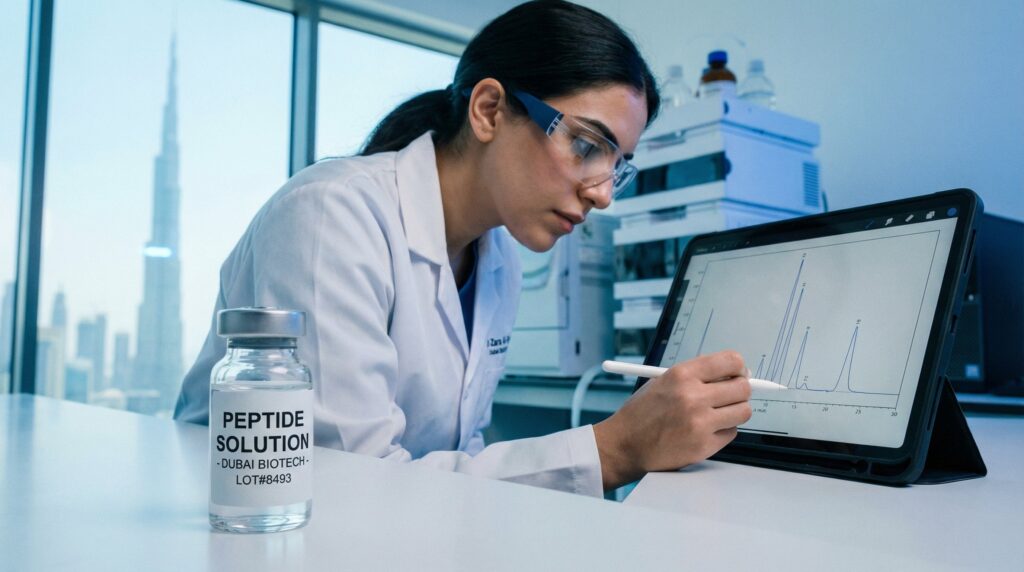
The Essential Checklist for HPLC Tested Peptides Dubai
Quick Answer: When sourcing hplc tested peptides dubai, researchers must verify third-party Certificates of Analysis (COAs) containing both an HPLC chromatogram (proving >99% purity) and Mass Spectrometry data (confirming molecular identity). Always buy lyophilised powder to withstand UAE heat, avoiding unregulated suppliers lacking batch-specific analytical testing.
Finding genuine research chemicals in the UAE requires a rigorous approach to analytical chemistry documentation. Researchers must independently verify that compounds exceed 99% purity and are free from structural degradation caused by extreme local heat.
The biochemical research sector in the United Arab Emirates is highly fragmented. Navigating the divide between high-markup clinical wellness programmes, unregulated fitness channels, and direct research suppliers requires a solid understanding of how to read laboratory data. When structural integrity and uncompromised purity are the foundation of your in vitro laboratory work, relying on a supplier’s verbal guarantee is an unacceptable risk.
This guide breaks down exactly how to evaluate testing documentation, understand the critical logistics of UAE delivery, and identify a trustworthy hplc tested peptides supplier dubai.
The Research Chemical Landscape in the UAE
The current biochemical market in Dubai showcases a significant pricing and format divide based on how compounds are formulated and distributed. Elite clinical operations charge premium rates for pre-mixed solutions tailored for specific protocols. These formulations, while strictly controlled, frequently include massive markups and mandatory consultation or blood panel fees.
Conversely, direct Research-Use-Only (RUO) suppliers provide pure, lyophilised (freeze-dried) powder vials at a fraction of that cost. This route is essential for institutional, academic, and independent researchers who need precise control over reconstitution variables like solvent type, pH, and concentration. However, skipping the clinic markup places the burden of quality control squarely on the buyer. Purchasing RUO compounds demands strict verification protocols to avoid under-dosed vials, degraded sequences, or contaminated batches that could permanently skew cellular assay data.
Decrypting the COA: High-Performance Liquid Chromatography (HPLC)
The cornerstone of procuring hplc tested peptides in dubai is the Certificate of Analysis (COA). A legitimate COA is not merely a typed document stating “99% Purity”; it must be a comprehensive laboratory report detailing two distinct analytical methodologies.
How HPLC Works
High-Performance Liquid Chromatography separates the components of a mixture using a stationary phase (typically a packed column) and a mobile phase (a liquid solvent). As the peptide solution is pumped through the column under high pressure, different molecules pass through at different speeds based on their chemical properties. The resulting graph, known as a chromatogram, displays peaks representing these different molecules over time (Retention Time).
Reading the Chromatogram
When reviewing an HPLC report for research compounds, look for:
- A Single, Dominant Peak: The primary peak should shoot straight up, indicating that the target compound makes up the vast majority of the vial.
- A Flat Baseline: A jagged or “noisy” baseline across the X-axis often indicates widespread low-level contamination, solvent residue, or incomplete synthesis.
- Area Under the Curve (AUC): The purity percentage is calculated by comparing the area of the main peak against the area of all secondary peaks (impurities). For high-grade research, a purity of ≥98% to 99% is the minimum acceptable standard.
However, it is vital to remember that HPLC alone only proves that a vial contains a clean substance. It does not prove what that substance actually is.
The Critical Role of Mass Spectrometry (MS)
To confirm molecular identity, the testing laboratory must perform Mass Spectrometry to measure the mass-to-charge ratio (m/z) of ions. Every peptide has a specific, well-documented molecular weight based on its exact amino acid sequence.
During testing, the sample is ionized—often via Electrospray Ionization (ESI) or Matrix-Assisted Laser Desorption/Ionization (MALDI)—and passed through a magnetic field. A reliable MS report will show a primary mass matching the theoretical molecular weight of the target peptide within a tiny margin of error (typically ±0.5 Daltons).
If an hplc tested peptides shop dubai provides a purity percentage without accompanying mass spectrometry data, the verification process is incomplete. Without MS, a vial could contain 99% pure mannitol (a common filler) or the completely wrong peptide sequence, and the HPLC would still show a perfect, single peak.
Beyond Purity: Endotoxins and TFA Salts
Even with confirmed identity and high purity, researchers must be aware of hidden impurities that can compromise delicate experiments.
Truncated Sequences
Peptide synthesis is complex, often involving dozens of sequential amino acid additions. Synthesis errors can lead to truncated sequences—fragments that failed to complete the full chain but are structurally similar enough to occasionally co-elute (appear at the same time) during poor-quality HPLC testing. High-resolution HPLC methods are required to separate these closely related impurities.
Endotoxin Contamination
If manufacturing occurs in sub-standard, non-sterile facilities, bacterial endotoxins can contaminate the batch. Endotoxins trigger severe inflammatory responses in cellular assays, entirely skewing in vitro data. The highest echelon of third-party testing frequently includes Limulus Amebocyte Lysate (LAL) testing to screen for endotoxin loads.
Trifluoroacetic Acid (TFA) Residue
TFA is a strong acid used to cleave peptides from the solid support resin during synthesis. While a small amount of TFA salt is standard in RUO peptides, excessive TFA can be highly toxic to cell cultures. Reputable laboratories ensure that TFA is properly exchanged or minimized during the final purification stages.
Desert Logistics: Protecting Peptides in the GCC Summer
In the UAE, exceptional laboratory testing means nothing if logistics fail. The extreme heat in the Gulf—frequently exceeding 40°C in the summer—represents a primary threat to biochemical stability. High temperatures can rapidly accelerate chemical degradation, break delicate peptide bonds, and render a 99% pure vial completely useless before it even reaches your laboratory.
To mitigate these risks, informed buyers look for:
- Lyophilised Formats: Peptides in a freeze-dried powder state are exponentially more stable against temperature fluctuations than pre-mixed liquids. Lyophilised vials can generally withstand short-term transit in warm climates without degrading.
- Unbroken Transit: Advanced packaging solutions that insulate vials from ambient heat during transit are essential. Relying on standard courier services without specialized handling is a major risk.
- Express Local Delivery: Top local suppliers operate with 1-2 day express shipping across Dubai, Abu Dhabi, and Sharjah, ensuring minimal transit time compared to international imports that may sit in hot customs warehouses for weeks.
How NOVA Labs Sets the Verification Standard
At NOVA Labs, trust in the RUO market is built entirely on transparency and empirical data. We understand that institutional and independent researchers require absolute certainty before introducing a compound to an assay. We maintain public, batch-linked ledgers containing complete HPLC chromatograms, mass spectrum verifications, and comprehensive impurity panels.
Before integrating any compound into your research protocols, you can review the exact third-party documentation tied to your specific vial by visiting our comprehensive lab results.
Furthermore, to accommodate researchers in the GCC, our logistics network is optimised for the local climate with rapid, secure delivery across the UAE. We support flexible procurement with payment options spanning credit cards, bank transfers, and digital assets, complemented by dedicated, locally responsive WhatsApp support for institutional orders and technical queries.
Conclusion
Procuring sensitive biochemicals in a high-temperature region requires a defensive, data-first approach. From verifying the precision of a chromatogram’s baseline to confirming molecular identity via Mass Spectrometry and ensuring safe cold-chain transit, the burden of quality assurance rests on demanding comprehensive documentation.
By sourcing exclusively from suppliers that offer transparent, batch-matched testing and reliable GCC logistics, you protect the integrity of your research data. Do not settle for verbal guarantees or incomplete paperwork. When you are ready to source verified hplc tested peptides dubai, prioritise suppliers who let the raw analytical data speak for itself.
Ready to stock your laboratory with verified compounds? Explore our complete product catalogue to view our current inventory of third-party tested, lyophilised research compounds, and secure your materials with confidence.
Disclaimer: The products mentioned in this article are strictly for in vitro laboratory research purposes only and are not intended for human consumption, diagnostic, or therapeutic use.
References
- High-Performance Liquid Chromatography and Mass Spectrometry in Peptide Analysis. Journal of Chromatography & Separation Techniques.
- Best Practices for Research Chemical Logistics in High-Temperature Climates. Supply Chain & Pharmaceutical Transport Review.
- Guidelines for Certificate of Analysis Verification. Analytical Chemistry and Quality Control Standards.
- Matrix-Assisted Laser Desorption/Ionization (MALDI) Mass Spectrometry of Peptides. Mass Spectrometry Reviews.
- Peptides : r/dubai – Reddit
- CJC-1295 No DAC – Peptide Guide UAE
- SequenceLabs
- How to Read a Certificate of Analysis (COA): HPLC vs. Mass Spec | ONYX BIOLABS
- Best Cold Chain Logistics for Pharmaceuticals Dubai for 2026
- Peptides Lab UAE
- Peptide Certificates of Analysis: How to Read and Verify a COA (2026 Guide) | Peptidepedia
Frequently asked questions
Why is HPLC testing important for research peptides?
HPLC testing determines the exact purity percentage of a peptide batch by separating its components. This ensures researchers are not working with contaminated compounds, excessive solvent residues, or degraded byproducts that could ruin sensitive cellular assays.
What is the difference between HPLC and Mass Spectrometry?
HPLC measures the purity and cleanliness of the sample by separating molecules, while Mass Spectrometry (MS) verifies the exact molecular weight to confirm the compound's actual structural identity.
Does the UAE heat affect peptide stability during shipping?
Yes, extreme ambient temperatures in the GCC can rapidly degrade delicate peptide bonds, especially in liquid form. This is why rapid local transit and sourcing lyophilised (freeze-dried) powder formats are critical to preserving compound integrity in Dubai.
How can I verify a Certificate of Analysis (COA) in Dubai?
Check that the COA is issued by an independent third-party laboratory, verify that it matches the exact batch number printed on your vial, and ensure it includes both the raw HPLC chromatogram image and the corresponding Mass Spectrometry m/z data.
Nova Labs buyer tools
Ready to verify stock, testing and delivery?
Use the product page and lab report section to check availability, documentation, delivery timing and support before placing an order.
- COA / test-report checks
- Dubai delivery context
- Cold-chain handling
- COD and card payment options
- WhatsApp support