

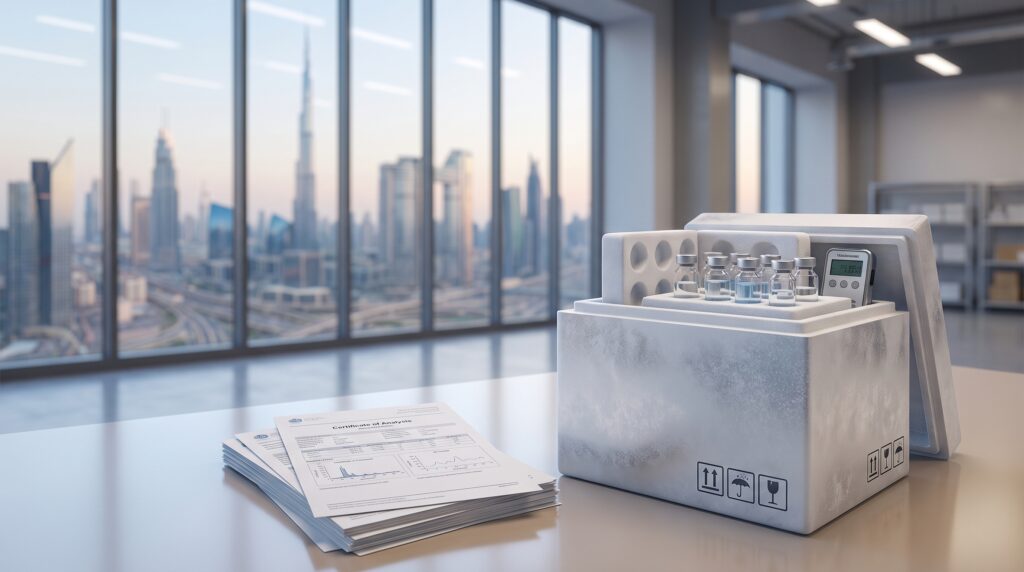
Sourcing HPLC Tested Peptides Saudi Arabia
When sourcing HPLC tested peptides, Saudi Arabia based researchers must verify independent Certificates of Analysis (COA) showing ≥98% purity. Buyers must also confirm compound identity via Mass Spectrometry (MS) and secure robust cold-chain shipping to protect structural integrity against extreme GCC temperatures during transit.
Procuring high-quality research reagents in the Middle East presents unique regional challenges. From navigating stringent Saudi Food and Drug Authority (SFDA) customs requirements to managing the logistical risks of the intense summer climate, procurement staff and independent researchers must exercise extreme diligence. The international market is saturated with vendors making unverified claims, making it critical to understand precisely how to read analytical laboratory data.
This guide breaks down the core components of peptide quality verification, detailing how to interpret high-performance liquid chromatography (HPLC) charts, mass spectrometry (MS) reports, and the operational hallmarks of a trustworthy HPLC tested peptides supplier in Saudi Arabia.
The Buyer’s Purity Checklist: What Matters Most
When evaluating any chemical supplier, the Certificate of Analysis (COA) serves as the primary instrument of trust. However, a COA is only as valuable as the independent laboratory that generated it and the specific data points it provides. Researchers should never accept an in-house document without third-party validation.
High-Performance Liquid Chromatography (HPLC)
HPLC is the industry’s standard method for quantifying the purity of a lyophilized peptide. The process works by dissolving the compound and passing it through a column under high pressure, separating the target peptide from any synthesis byproducts or truncated sequences.
When reviewing an HPLC report, look for the Area% metric. A high-quality research peptide should demonstrate an Area% of ≥98%, and ideally ≥99%. On the visual chromatogram, this appears as a single, sharp, dominant peak. The baseline of the chart should be relatively flat; excessive secondary peaks indicate poor synthesis or degradation, meaning the compound is contaminated with impurities that could skew in-vitro research results.
Mass Spectrometry (MS)
While HPLC confirms how pure the powder is, Mass Spectrometry (MS) confirms that the powder is actually the correct compound. MS measures the mass-to-charge ratio of ions, allowing the laboratory to determine the exact molecular weight of the sample.
Every peptide has a theoretical molecular weight based on its amino acid sequence. When reading the MS data (often utilizing standard ESI-MS), the actual measured weight must form a tight match with the theoretical weight, typically within a strict tolerance of +/- 0.5 Da. If the mass deviates beyond this window, the sequence is incorrect, and the batch must be rejected.
How to Verify Independent COA Data
Finding an HPLC tested peptides shop in Saudi Arabia is only the first step; verifying their documentation is where many buyers falter. Fraudulent COAs are unfortunately common in the global research reagent market. Unscrupulous sellers may alter dates, modify batch numbers, or simply copy a chromatogram chart from another vendor’s website.
To protect your research investments, follow these critical verification steps:
- Check the Laboratory: Legitimate tests are conducted by recognized, independent third-party analytical laboratories (such as Janoshik or MZ Biolabs). Avoid suppliers who only provide internally generated, unbranded testing documents.
- Use the Verification Key: Modern, trustworthy COA reports include a unique verification code or URL. You should be able to visit the independent laboratory’s official website, enter the code, and view the original, unaltered document directly from their database.
- Match the Batch Number: The batch number printed on your physical peptide vial must precisely match the batch number listed on the corresponding HPLC report. If they do not align, the test data is irrelevant to the product you received.
For researchers who require total transparency before procuring reagents, you can review our independent batch-testing data and COA reports to see exactly how rigorous documentation should be presented.
GCC Logistics: Why Cold-Chain Shipping is Non-Negotiable
Sourcing high-purity materials is ultimately useless if the shipping logistics fail to protect the compound from the local climate. Saudi Arabia experiences extreme temperatures, frequently exceeding 40 degrees Celsius during the extended summer months, particularly in logistics hubs like Riyadh and Jeddah.
Lyophilized (freeze-dried) peptides are generally more stable than liquid suspensions, but they are not immune to thermal degradation. Prolonged exposure to extreme heat in a courier van or an un-air-conditioned customs warehouse can break down the delicate amino acid bonds, ruining the peptide’s structural integrity before it ever reaches the laboratory bench.
Top-tier suppliers addressing the GCC market invest heavily in temperature-controlled logistics. This includes utilizing insulated mailers, medical-grade cold packs, and expedited regional courier networks. If a vendor ships fragile compounds in standard envelopes via slow international post, the risk of degradation increases exponentially.
Navigating Saudi Customs for Research Reagents
The Saudi Food and Drug Authority (SFDA) strictly regulates the importation of chemical and biological materials. Standard consumer shipments are heavily scrutinized, and research reagents lacking proper documentation face a high probability of customs rejection or seizure.
When purchasing research compounds internationally, the accompanying commercial invoice and import documentation must be meticulously prepared. Peptides destined for laboratory study must be clearly labeled as “Research Use Only” (RUO). This classification signals to customs authorities that the materials are exempt from certain retail pharmaceutical regulations, provided they are bound for legitimate research environments.
Reputable suppliers mitigate border delays by offering comprehensive shipping protection and localized dispatch options.
Evaluating Your Supply Partner
Selecting a long-term HPLC tested peptides supplier in Saudi Arabia requires evaluating their entire operational footprint, not just their product list. The most reliable vendors offer a frictionless, localized buying experience tailored to the realities of the Middle Eastern market.
Key operational signals include:
- Local Dispatch Points: Suppliers dispatching directly from the UAE or wider GCC region can bypass lengthy international transit times, significantly reducing the window for thermal degradation.
- Responsive Support: Procurement moves quickly. The availability of direct WhatsApp support for inventory checks, documentation requests, and transit updates is a strong indicator of a supplier’s commitment to service.
- Flexible Payment: Look for vendors that accommodate local payment preferences, including secure card processing, local bank transfers, or cryptocurrency options where applicable.
Once you have verified their analytical rigor and logistics infrastructure, you can confidently explore our complete catalogue of research reagents to find the precise compounds required for your upcoming studies.
Conclusion and Next Steps
Securing verifiable research materials requires a deliberate, evidence-based approach to procurement. By insisting on independent, verifiable COAs with an Area% of ≥98%, confirming molecular identity via precise MS data, and ensuring your supplier utilizes robust cold-chain shipping protocols, you can safeguard the integrity of your research.
Always scrutinize the documentation, verify the laboratory codes, and factor in the realities of GCC logistics and SFDA customs clearance before finalizing any purchase.
Disclaimer: The products mentioned in this article are for in-vitro research purposes only and are not intended for human or animal consumption.
References
- Saudi Food and Drug Authority (SFDA). (2023). Guidelines for the Importation of Laboratory Chemicals and Reagents.
- Journal of Chromatographic Science. (2022). High-Performance Liquid Chromatography (HPLC) for Peptide Purity Analysis.
- Janoshik Analytical. (2024). Independent Laboratory Verification Methodologies and Best Practices.
- Research Peptides Riyadh — Regena Peptides Costa del Sol
- Peptide Laws in Saudi Arabia — Can You Buy, Travel & Import? (2026)
- Shipping & Returns Saudia Arabia – DirectPeptides
- How to Read a Peptide Certificate of Analysis (COA): UK Researcher’s Guide (2026)
- Peptide Certificates of Analysis: How to Read and Verify a COA (2026 Guide) | Peptidepedia
- Shipping – Pure Peptides Shop
- Peptide Supplier for Saudi Arabia | B2B Research Peptide Supply – BT BioLabs
- Janoshik Verify: Check Any Test Report in 60 Seconds (2026) – Durham Peptides
Frequently asked questions
How can I verify if an HPLC test report is genuine?
Genuine reports include a unique verification code that can be entered directly on the independent testing laboratory's website, such as Janoshik or MZ Biolabs, to retrieve the original, unaltered PDF document.
What is an acceptable HPLC purity level for research peptides?
The industry standard for research-grade materials is an HPLC Area% of 98% or higher, which indicates minimal synthesis impurities and a clean, reliable compound for in-vitro studies.
Why do peptides shipped to Saudi Arabia require cold-chain logistics?
Extreme GCC temperatures, frequently exceeding 40 degrees Celsius in hubs like Riyadh, can rapidly degrade lyophilized peptides. Insulated packaging and medical-grade ice packs are essential for maintaining compound structural stability during transit.
What documentation is needed to import research peptides into Saudi Arabia?
Shipments require a clear "Research Use Only" (RUO) declaration, a precise commercial invoice, and proper HS codes to navigate Saudi Food and Drug Authority (SFDA) customs clearance smoothly.
Nova Labs buyer tools
Ready to verify stock, testing and delivery?
Use the product page and lab report section to check availability, documentation, delivery timing and support before placing an order.
- COA / test-report checks
- Saudi Arabia delivery context
- Cold-chain handling
- COD and card payment options
- WhatsApp support