
Key Takeaways for UAE Researchers
- Calculations: 1mg of lyophilized peptide equals 1,000mcg. Always determine total micrograms before dividing by your diluent volume.
- Reconstitution Mechanics: Avoid the “water hammer” effect by breaking the vial’s vacuum gently and angling bacteriostatic water down the side of the glass.
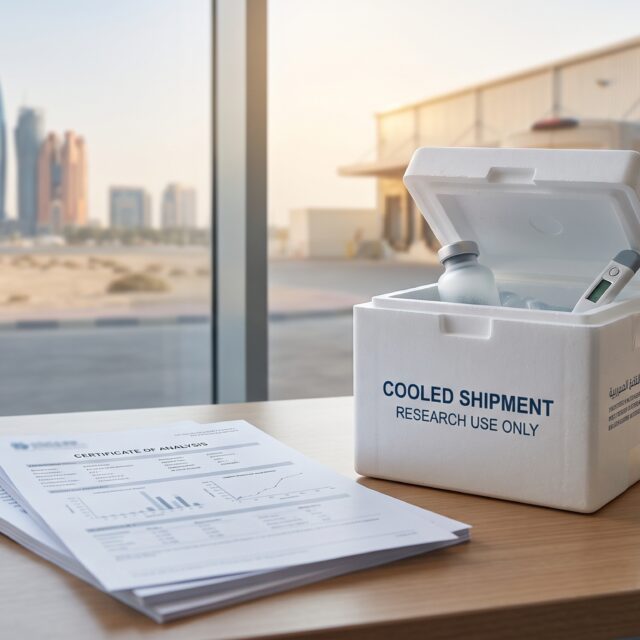
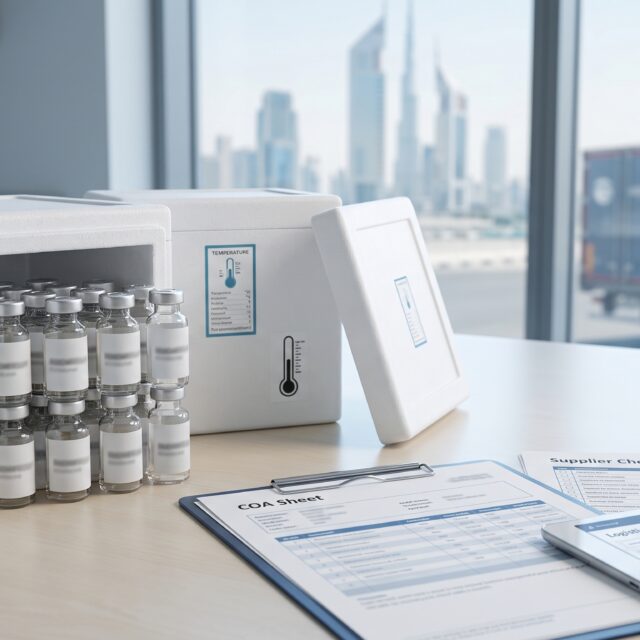
- Cold-Chain Logistics: GCC climates demand thermal shippers and fast regional fulfillment; prolonged unrefrigerated transit can denature peptide bonds.
- Quality Verification: Only source compounds validated by third-party High-Performance Liquid Chromatography (HPLC) and Mass Spectrometry (MS) documentation.
Mastering Peptide Dosage: The Foundations of Reconstitution
Mastering peptide dosage requires calculating total milligrams (mg) of lyophilized powder, the volume of bacteriostatic water (ml) used for reconstitution, and syringe units. Accurate calculation ensures precise microgram (mcg) aliquots, protecting research data integrity. Local cold-chain logistics in the UAE are equally essential to prevent compound degradation.
For researchers and laboratory professionals operating in the UAE and the broader GCC, establishing strict protocols for handling delicate biological compounds is paramount. Unlike pre-mixed liquid solutions, high-grade research peptides arrive as a lyophilized (freeze-dried) powder. This format removes moisture under a vacuum, maximizing stability during transit, but it leaves behind a highly porous, fragile structure that requires meticulous mathematical calculation and careful physical handling prior to any in vitro assay.
Transitioning from raw powder to an accurate, sterile liquid solution demands uncompromising precision. A single miscalculation in the reconstitution phase can completely alter the concentration of a drawn aliquot, rendering months of research data invalid. In this guide, we break down the mechanics of microgram mathematics, the vital physical handling steps required to protect fragile amino acid chains, and the unique logistical considerations of procuring and storing these compounds in the extreme climate of the UAE.
The Math of Micrograms: Calculating Variables in the Lab
The most common hurdle when mastering peptide dosage is translating the milligrams printed on the vial into the micrograms required for a specific laboratory application. Lyophilized peptides are almost universally measured and sold in milligrams (mg), whereas most experimental applications require highly specific, minute concentrations measured in micrograms (mcg).
To ensure complete accuracy, researchers must firmly grasp the baseline metric conversion:
- 1 milligram (mg) = 1,000 micrograms (mcg)
When a researcher introduces a diluent—typically bacteriostatic water containing 0.9% benzyl alcohol, which extends the sterile shelf life of a multidose vial to between 28 and 45 days—they are establishing the concentration ratio for the entire vial.
Consider a standard laboratory scenario involving a vial containing 10mg of lyophilized powder. If a researcher adds 3ml (milliliters) of bacteriostatic water to this vial, the calculation proceeds as follows:
- Convert the total peptide mass to micrograms: 10mg x 1,000 = 10,000mcg total.
- Divide the total micrograms by the volume of water: 10,000mcg / 3ml = 3,333.3mcg per 1ml.
- Assess the measuring tool: A standard 1ml analytical syringe (often a U-100 syringe) is typically divided into 100 units (often referred to as ‘ticks’ or ‘marks’).
- Determine the per-unit concentration: Divide the per-milliliter concentration by 100. In this case, 3,333.3mcg / 100 units = 33.3mcg per single unit.
By fully understanding this three-variable formula (total mg, total ml of diluent, and syringe units), laboratory staff can draw exact aliquots without guesswork. It is critical to standardize the volume of bacteriostatic water used across batches to maintain strict consistency in longitudinal cell culture studies.
Proper Handling: Avoiding the “Water Hammer” Effect
Mathematical accuracy is only half of the equation; physical handling is equally critical. Peptides are essentially short chains of amino acids connected by delicate covalent peptide bonds. While stable in powder form, these molecular structures become highly susceptible to mechanical shear stress, thermal degradation, and contamination the moment reconstitution begins.
A frequent error during reconstitution is the forceful introduction of bacteriostatic water into the vial. Because peptide vials are sealed in a vacuum environment during the lyophilization process, piercing the rubber stopper with a syringe can cause the diluent to rapidly shoot into the vial. If this liquid forcefully impacts the delicate powder directly, it creates a “water hammer” effect. This mechanical force can physically shear and fragment the molecular sequence, essentially destroying the compound before the study even begins.
Best Practices for Reconstitution in the Lab:
- Sanitize the Stopper: Always swab the rubber stopper of both the bacteriostatic water and the peptide vial with 70% isopropyl alcohol to maintain strict sterility.
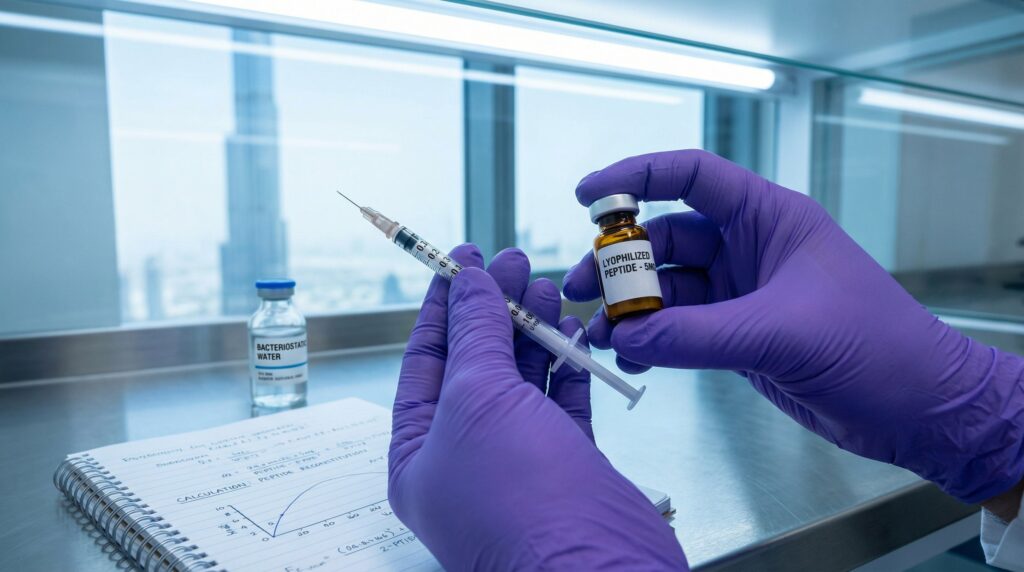
- Release the Vacuum Gently: Allow the vacuum to pull the bacteriostatic water into the vial naturally, but control the plunger with your thumb to ensure a slow, deliberate flow.
- Drip Down the Glass: Angle the needle so that the liquid flows down the inside wall of the glass vial rather than spraying directly onto the lyophilized “puck” at the bottom.
- Swirl, Never Shake: Once the diluent is added, the vial must never be vigorously shaken. Instead, gently swirl the vial in a circular motion until the powder is completely dissolved into a clear solution. Cloudy solutions or lingering particulates can indicate incomplete dissolution, compromised sterility, or a degraded compound.
The UAE Climate Challenge: Cold-Chain Logistics
The environmental realities of the United Arab Emirates present unique, highly specific challenges for researchers procuring biological materials. With summer temperatures frequently exceeding 45°C, standard shipping practices are entirely insufficient for delicate laboratory peptides. Exposure to intense ambient heat for even a few hours can permanently denature the amino acid chains, rendering the research material completely inert and useless for laboratory assays.
Consequently, procuring these compounds in Dubai, Abu Dhabi, or the wider GCC requires a supplier with a fully validated cold-chain logistics network. Unreconstituted lyophilized powders can survive very brief transit at controlled room temperatures, but for absolute stability, they should be maintained between 2°C and 8°C. Once reconstituted with bacteriostatic water, the solution must be refrigerated immediately (2 to 8°C) and strictly protected from direct ultraviolet light. Reconstituted peptides should never be frozen, as the freeze-thaw cycle will expand the water and destroy the fragile peptide bonds.
Because of these stringent temperature requirements, localized delivery infrastructure is crucial. Many international fulfillment operations struggle with last-mile delivery in the UAE. Standard courier delays, packages left in hot delivery vans, or failed delivery attempts can silently ruin an expensive batch.
To mitigate these environmental risks, securing a fast, localized supply chain is imperative. For instance, prioritizing peptides UAE next-day delivery ensures that temperature-sensitive shipments spend the absolute minimum time in transit, arriving intact in thermal shippers and ready for immediate refrigeration.
This environmental reality is also why reputable regional suppliers often restrict or entirely reject Cash on Delivery (COD) options for sensitive biologicals; the risk of a missed delivery attempt or payment delay means the product spends an extra, potentially fatal, day in an uncontrolled thermal environment.
Evaluating Supplier Integrity: COAs and Compliance
Navigating the peptide market in the UAE requires a clear understanding of the regulatory landscape and a strict standard for supplier evaluation. The Dubai Health Authority (DHA) and the Ministry of Health and Prevention (MoHAP) tightly regulate clinical peptide therapies intended for human application. However, the compounds discussed in this guide are strictly designated for in vitro research and laboratory use.
When sourcing these materials, the most critical document a buyer must review is the Certificate of Analysis (COA). A valid COA should be backed by third-party testing utilizing two distinct methodologies:
- High-Performance Liquid Chromatography (HPLC): This tests for purity. Researchers should look for a purity threshold exceeding 98.5%, indicated by a single, sharp peak on the report without significant truncated sequences or impurities.
- Mass Spectrometry (MS): This verifies the net content and mass. It confirms that the molecular weight (measured in Daltons) exactly matches the targeted compound, ensuring you are testing the correct amino acid sequence.
- TFA Salt Removal: High-grade lab peptides should be purified to remove excess Trifluoroacetic acid (TFA) salts, which are used during synthesis but can be cytotoxic in sensitive cell culture assays if left behind.
Transparency and operational expertise form the foundation of reliable research. At NOVA Labs, we ensure that verifiable COAs are accessible for every batch, allowing researchers to validate their materials before ever starting an experiment. Dedicated local support via WhatsApp, secure regional payment gateways, and rigorous cold-chain stock management mean researchers can focus entirely on their protocols rather than battling supply chain friction.
Conclusion and Next Steps
Successfully executing in vitro studies requires more than just high-quality compounds; it requires an operational understanding of how those compounds behave from the moment they arrive at the loading dock to the moment they are pipetted onto a well plate. Mastering peptide dosage is a fundamental skill that bridges the gap between raw lyophilized powder and precise, actionable research data. By carefully calculating the ratio of total milligrams to milliliters of bacteriostatic water, researchers can draw exact microgram concentrations for any assay.
Furthermore, recognizing the extreme environmental constraints of the UAE emphasizes the absolute necessity of proper handling, gentle reconstitution techniques, and strict adherence to 2–8°C cold-chain storage. When purchasing materials, always prioritize suppliers who provide transparent, third-party verifiable COAs and robust localized delivery infrastructure.
Ensure your laboratory is equipped with the precise mathematical frameworks and high-purity compounds needed for reliable data. Verify your calculations, check your supplier’s HPLC documentation, and when you are ready to secure high-purity biologicals for your laboratory, explore our complete catalog of third-party tested, cold-chain protected verified research peptides at NOVA Labs.
Disclaimer: The products and compounds mentioned in this article are strictly for research and laboratory purposes only. They are not intended for human consumption, therapeutic, diagnostic, or clinical application.
References
- Guidelines for Peptide Reconstitution and Storage. National Center for Biotechnology Information (NCBI).
- Cold Chain Logistics in Extreme Climates. UAE Ministry of Climate Change and Environment (MOCCAE) Reports.
- Laboratory Handling of Lyophilized Biologicals. Journal of Biological Standardization.
- High-Performance Liquid Chromatography in Peptide Analysis. Journal of Chromatography.
- Peptide Calculator – Cellgenic
- Cold Chain Solutions in UAE | Freezpak
Disclaimer: The products mentioned in this article are for research purposes only and are not intended for human consumption.
- Peptide Dosing Guidelines | Clinical Protocols
- Essential Guide to Peptide Dosages: How to Safely Optimize Your Results
- Peptide Math — How to Easily (and Accurately) Calculate Doses – Medium
- Reconstituting Peptides: A Beginner’s Guide
- Peptide Therapy in Dubai & Abu Dhabi | DNA Health and Wellness
- Shipping Policy – Fast Delivery Across UAE – nanopep
Frequently asked questions
How long does a reconstituted peptide last?
When reconstituted with bacteriostatic water containing 0.9% benzyl alcohol and stored continuously in a refrigerator at 2 to 8°C, a multidose peptide vial typically maintains its sterile shelf life for 28 to 45 days before beginning to degrade.
How do I calculate microgram concentration in a peptide vial?
Multiply the total milligrams of lyophilized powder by 1,000 to find the total micrograms. Then, divide that total by the milliliters of bacteriostatic water added to determine the specific microgram concentration per milliliter.
Why should you avoid shaking a peptide vial during reconstitution?
Peptides consist of delicate covalent amino acid chains that are highly susceptible to mechanical shear stress. Vigorously shaking the vial can break these molecular bonds and degrade the compound; therefore, the diluent should be added slowly down the glass and swirled gently.
How do UAE summer temperatures affect peptide shipments?
Ambient heat exceeding 45°C can rapidly denature lyophilized peptides, destroying their structural integrity. To preserve them for research, these compounds require strict cold-chain logistics utilizing thermal shippers to maintain an optimal transit temperature of 2 to 8°C.
What is the difference between clinical and research peptides in Dubai?
Clinical peptide therapies are tightly regulated by the Dubai Health Authority (DHA) and MoHAP for patient use. Conversely, research peptides are classified strictly for in vitro laboratory studies and require comprehensive Certificates of Analysis (COAs), like HPLC and Mass Spectrometry, for purity verification.
Nova Labs buyer tools
Ready to verify stock, testing and delivery?
Use the product page and lab report section to check availability, documentation, delivery timing and support before placing an order.
- COA / test-report checks
- UAE delivery context
- Cold-chain handling
- COD and card payment options
- WhatsApp support