

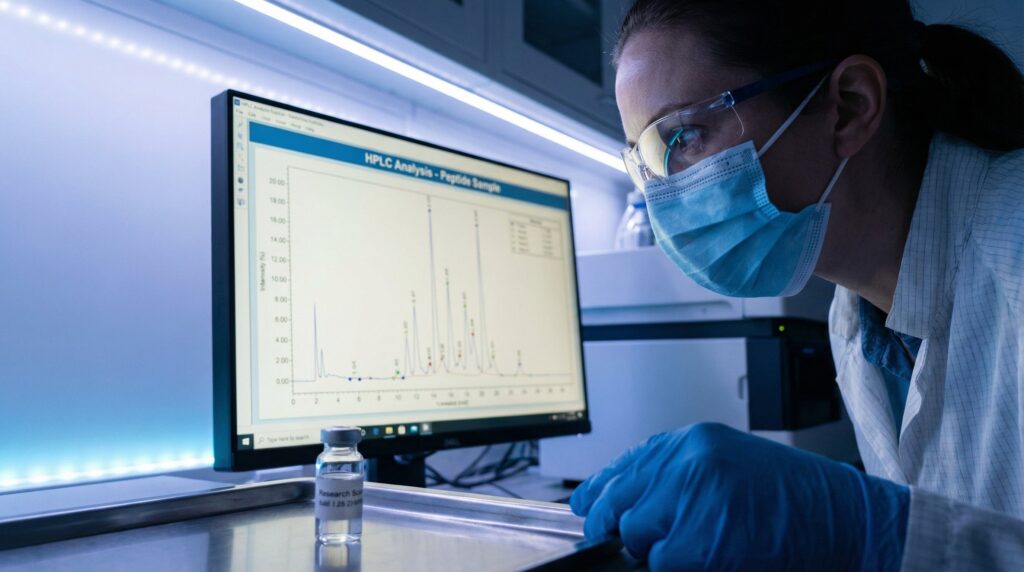
Procuring high-quality research compounds in the GCC region has evolved significantly. As local demand for precision biosciences grows, researchers are increasingly cautious of generic marketing claims. For laboratories and independent researchers sourcing HPLC tested peptides UAE, a simple “99% pure” label on a vial is no longer sufficient. Analytical proof is required.
The influx of unverified materials in the global market means that UAE-based buyers must know exactly how to evaluate a supplier’s documentation. The emergence of strict clinical compounding standards in places like Dubai has raised the baseline expectations for research-grade materials. Today, acquiring peptides requires verifying batch-specific Certificates of Analysis (COAs), understanding complex chromatography data, and ensuring the supplier has the cold-chain logistics necessary to protect delicate amino acid sequences from the extreme Gulf heat.
Quick Buyer Checklist: HPLC Tested Peptides UAE
When sourcing HPLC tested peptides in the UAE, always demand a batch-specific Certificate of Analysis (COA). Look for Reversed-Phase HPLC data confirming purity above 99%, accompanied by Mass Spectrometry (MS) verifying molecular weight, and ensure the supplier utilizes cold-chain UAE delivery to prevent heat degradation.
The Science of Verification: HPLC vs. Mass Spectrometry
To confidently source from an HPLC tested peptides supplier UAE, buyers must first understand the tandem analytical methods used to quantify quality: High-Performance Liquid Chromatography (HPLC) and Mass Spectrometry (MS). They serve completely different but equally critical functions.
Reversed-Phase HPLC (RP-HPLC) for Purity
Peptide purity quantification primarily relies on Reversed-Phase High-Performance Liquid Chromatography (RP-HPLC). This process separates the target amino acid sequence from synthesis impurities—such as deletion sequences, truncation variants, or synthesis by-products—based on hydrophobicity. As the sample passes through the analytical column, different molecules emerge at different times.
The resulting chromatogram displays these molecules as peaks. HPLC purity is calculated as the ratio of the main UV detector peak area (the primary compound) to the total area of all detected peaks combined. Therefore, an authentic claim of “≥99% purity” explicitly means that all detected impurities account for less than 1% of the total sample volume.
Mass Spectrometry (MS) for Identity
While HPLC is excellent for determining relative sample purity, it cannot tell you what the substance actually is. A sample could be 99.9% pure table sugar, and HPLC would simply show a single, very clean peak.
This is why Mass Spectrometry (MS) is mandatory alongside HPLC. MS verifies the molecular identity by measuring the mass-to-charge ratio (m/z). Every peptide has a specific theoretical molecular weight based on its amino acid chain. The MS test confirms that the physical weight of the synthesized compound matches the expected molecular structure. Without MS data, an HPLC graph is functionally incomplete.
Decoding a Certificate of Analysis (COA) in the UAE
A Certificate of Analysis is the definitive document proving a peptide’s quality. However, as the market expands, identifying legitimate COAs from fabricated ones has become a necessary skill for procurement teams. When evaluating an HPLC tested peptides shop UAE, scrutinize their COA for the following verifiable data points:
- Matching Batch/Lot Numbers: The batch or lot number printed on the laboratory report must exactly match the number printed on the physical vial you receive. If a supplier uses a single generic COA for years of production, the data is meaningless for your specific vial.
- ISO/IEC 17025 Accreditation: The testing should ideally be conducted by a third-party laboratory holding ISO/IEC 17025 accreditation, ensuring their analytical methods meet international testing standards.
- Complete Residual Solvent Panels: Peptide synthesis heavily relies on solvents like N,N-Dimethylformamide (DMF) or trifluoroacetic acid (TFA). A rigorous COA will include residual solvent testing to prove these potentially toxic manufacturing by-products have been successfully purged during the lyophilization (freeze-drying) phase.
- Clear Chromatogram Graphs: Do not accept a simple text document stating “Purity: 99.2%”. You need to see the actual visual chromatogram graph with distinct peaks, retention times, and area integration tables.
Spotting Red Flags in Peptide Testing Reports
As you navigate the options for HPLC tested peptides in UAE, understanding what not to see is just as critical. Many low-trust suppliers use sophisticated techniques to obfuscate poor synthesis quality.
One significant red flag is an MS tolerance reported at ±0.1%. While 0.1% sounds precise to a layman, in the context of large peptide molecules, this variance is mathematically wide enough to hide incorrect amino acid substitutions. Modern LC-MS/MS equipment should maintain accuracy within parts per million (ppm). Wide tolerances are often used to mask synthetic errors that occur during the complex assembly of longer amino chains.
Additionally, examine the PDF metadata and date alignment. Redacted laboratory names, blurry graphs overlaid with crisp text, or dates that precede the stated synthesis date are all indicators of altered documentation.
The GCC Summer Heat Threat: Why Cold-Chain Logistics Matter
Verifying a pristine COA is only half the battle. A peptide that tests at 99.8% purity at the manufacturing facility can rapidly degrade into fragmented, useless by-products if subjected to improper shipping conditions.
The extreme summer heat in Dubai, Abu Dhabi, and the wider GCC region poses a severe threat to peptide stability. Unstable lyophilized peptides—and especially those that have been reconstituted—can break down in a matter of hours if left in a sweltering delivery van.
Because of this, local operational infrastructure is critical. Buying internationally often means your package sits in hot customs warehouses for days. Reputable local suppliers mitigate this by holding stock in climate-controlled environments and dispatching orders directly from within the UAE. Temperature-controlled handling and fast local shipping (typically 24 to 48 hours within the emirates) are non-negotiable for preserving the integrity of sensitive research compounds.
Evaluating Your HPLC Tested Peptides Supplier UAE
Choosing the right partner for your research goes beyond viewing a single lab report. You are evaluating their entire supply chain, transparency, and operational reliability.
At NOVA Labs, we prioritize research integrity by providing transparent, batch-specific laboratory test results for our inventory. By focusing on stringent synthesis protocols and rigorous third-party testing, we ensure researchers have access to compounds that meet strict purity standards.
Furthermore, sourcing locally eliminates the high friction of international customs delays and product degradation. Buyers should look for suppliers that offer practical local solutions: secure, unbranded packaging for privacy, localized support via WhatsApp, Cash on Delivery (COD) options for transaction security, and fast dispatch windows that minimize transit time.
Summary
Securing high-purity research materials requires vigilance. Sourcing HPLC tested peptides UAE demands an understanding of analytical reporting, from verifying MS mass-to-charge ratios to ensuring HPLC purity ratios exceed 99%. By auditing batch numbers, demanding third-party lab transparency, and prioritizing local cold-chain logistics, researchers can protect their work from the risks of degraded or misidentified compounds.
If you are evaluating high-purity compounds for your next study, explore our fully documented research peptides collection to review our active batch test reports and secure rapid UAE logistics.
Disclaimer: The products mentioned in this article are for research purposes only and are not intended for human consumption.
*
References:
- Vanguard Laboratory. “The Ultimate Guide to HPLC Testing for Peptides.”
- Peptidepedia. “Peptide Certificates of Analysis: How to Read and Verify a COA.”
- Muscle And Brawn. “How To Read A Peptide COA.”
- UAE Lab Research. “Small Protein Synthesis & Analytical Protocols.”
References
- About Peptides Lab UAE
- The Science – Afiya Labs
- Bio-Core Peptides
- Peptide Certificates of Analysis: How to Read and Verify a COA (2026 Guide) | Peptidepedia
- The Ultimate Guide to HPLC Testing for Peptides – Vanguard Laboratory
- How To Read A Peptide COA | Muscle And Brawn
- UAE Lab Research – Small Protein Synthesis
Frequently asked questions
What does HPLC testing for peptides mean?
HPLC (High-Performance Liquid Chromatography) testing is an analytical method used to determine the purity of a peptide by separating the target compound from synthesis impurities based on molecular hydrophobicity.
Why is Mass Spectrometry (MS) required alongside HPLC?
While HPLC calculates the relative purity percentage of a sample, Mass Spectrometry (MS) is required to verify the molecular weight, confirming the substance is actually the specific peptide sequence intended.
How do I spot a fake peptide COA?
To spot a fake COA, look for missing or mismatched batch numbers between the vial and the report, MS tolerances wider than acceptable margins (like ±0.1%), missing chromatogram graphs, and a lack of third-party laboratory accreditation.
Does shipping heat affect HPLC tested peptides in the UAE?
Yes, extreme UAE summer heat can rapidly degrade even high-purity peptides. Utilizing local cold-chain logistics and fast 24-48 hour delivery is essential to preserve molecular stability during transit.
What is considered a high-purity HPLC peptide result?
For most rigorous research applications, an HPLC purity result of ≥99% is considered the gold standard, meaning all detectable synthesis impurities total less than 1% of the compound.
Nova Labs buyer tools
Ready to verify stock, testing and delivery?
Use the product page and lab report section to check availability, documentation, delivery timing and support before placing an order.
- COA / test-report checks
- UAE delivery context
- Cold-chain handling
- COD and card payment options
- WhatsApp support