



Sourcing highly purified research compounds in the Middle East presents a unique set of challenges. Between extreme summer temperatures, complex customs regulations, and varying standards of supplier transparency, laboratory professionals cannot rely on blind faith. Whether you are conducting long-term biochemical assays or short-term metabolic studies, analytical integrity is paramount. Finding reliable hplc tested peptides gcc researchers can trust requires a precise understanding of laboratory documentation, coupled with a robust local logistics network that protects fragile molecular structures from the desert heat.
In this guide, we break down exactly how informed buyers evaluate peptide purity, read analytical testing documents, and ensure their research materials arrive viable and intact.
HPLC Tested Peptides GCC: What Buyers Need to Know
For buyers seeking HPLC tested peptides GCC, high-performance liquid chromatography (HPLC) is the gold-standard analytical method used to verify research compound purity. By separating peptide molecules from impurities, HPLC testing ensures that GCC researchers receive highly purified batches that are properly documented and ready for precise laboratory application.
Beyond that top-level summary, understanding the mechanics of high-performance liquid chromatography is essential. When a laboratory synthesizes a peptide, the initial result is never 100% pure. The raw material often contains truncations, deletion sequences, and leftover synthesis reagents. HPLC passes this compound mixture through a column under high pressure, separating its constituent parts based on their molecular interactions. A detector then records these separated components, producing a chromatogram—a visual graph where peaks represent different substances. The area under the primary peak indicates the percentage of the target peptide relative to the peptidic impurities.
However, a simple claim of “99% purity” on a supplier’s website is insufficient. True laboratory transparency requires publicly accessible, batch-specific documentation that proves these claims.
Buyer Checklist: How to Verify a Peptide Certificate of Analysis (COA)
A Certificate of Analysis (COA) is a vital quality assurance document, but not all COAs are created equal. When evaluating a potential supplier for hplc tested peptides in gcc, buyers must scrutinize the data provided. Use this checklist to audit your next supplier.
- Look for Raw Chromatograms: A trustworthy COA will not just state a purity percentage; it will include the raw HPLC chromatography chart showing distinct, well-resolved peaks.
- Check for Mass Spectrometry (MS) Data: While HPLC verifies purity (how much of the sample is the target compound vs. impurities), Mass Spectrometry verifies identity (whether the molecular weight matches the exact amino acid sequence). Without MS data, you cannot guarantee you have the correct peptide.
- Understand HPLC Purity vs. Net Peptide Content (NPC): HPLC purity measures the peptide against peptidic impurities. Net Peptide Content (NPC) measures the percentage of total powder weight that is actual peptide, excluding counter-ions, moisture, and residual salts. Both metrics are vital for precise scientific formulations and reconstitution mathematics.
- Demand Third-Party Verification: In-house testing reports carry inherent bias. Reputable suppliers utilize independent, accredited third-party laboratories to generate their analytical data.
- Verify Batch Numbers: Ensure the batch number on your physical vial matches the batch number documented on the published COA.
For researchers who require stringent documentation, it is critical to verify independent lab results before committing to a purchase.
The GCC Climate Threat: Why Local Logistics Matter More Than Purity
A flawless HPLC report is meaningless if the compound degrades in transit. The GCC region presents one of the most hostile environments for peptide shipping globally, with ambient summer temperatures easily exceeding 40–45°C.
Unrefrigerated peptides degrade rapidly when exposed to temperatures above 25°C. Many international suppliers dispatch orders from North America or Asia via standard international air freight. These shipments can spend 14 to 21 days in transit, often sitting in sweltering cargo holds, un-air-conditioned sorting facilities, or on airport tarmacs. By the time the package clears local customs, the structural integrity of the peptide may be heavily compromised, rendering your highly pure compound analytically useless.
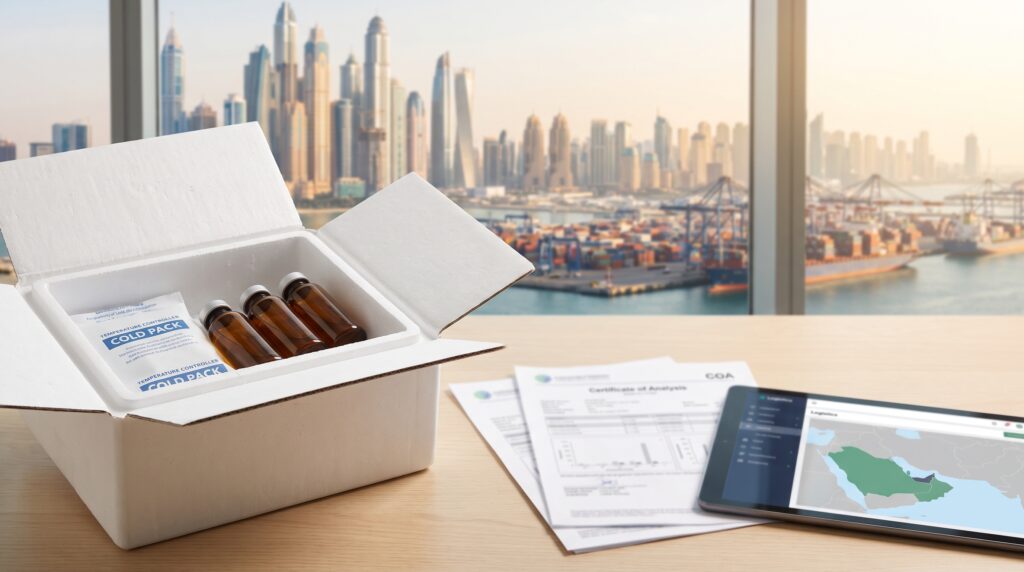
This is why finding a localized hplc tested peptides supplier gcc is a non-negotiable operational requirement. Localized suppliers operating out of hubs like Dubai utilize passive cold-chain logistics. By packing research compounds with vacuum-insulated panels or phase-change cooling gels, regional suppliers can maintain stable temperatures during transit.
Customs Clearance and Purchasing Friction in the Middle East
Beyond severe climate risks, researchers importing compounds from outside the GCC frequently encounter bureaucratic friction. International imports of research materials often face customs holds, long delays, requests for excessive documentation, or outright confiscation by local authorities enforcing strict importation regulations.
Partnering with a local supplier eliminates this logistical nightmare. Because the inventory is already cleared and warehoused within the UAE, regional distribution bypasses international borders for domestic orders, and drastically simplifies cross-border logistics to Saudi Arabia, Qatar, Oman, Kuwait, and Bahrain.
Furthermore, informed procurement staff in the GCC prefer localized checkouts. Instead of navigating foreign exchange fees or international wire transfers, buyers benefit from secure transactions in AED/SAR, cryptocurrency options, credit card processing, and direct updates via WhatsApp support channels.
Evaluating Your Next HPLC Tested Peptides Shop GCC
When conducting a supplier audit, the goal is to merge analytical transparency with operational reliability. The strongest laboratories do not merely sell compounds; they provide a comprehensive procurement ecosystem designed for the exact needs of the end user.
When comparing suppliers, look for a platform that structurally highlights its testing protocols. At NOVA Labs, we maintain a completely open and searchable public COA database, ensuring you have the precise data required to calculate accurate molar concentrations for your in vitro testing protocols. Furthermore, our Dubai-based operations mean that UAE clients typically receive same-day or next-day cooled shipping, while regional GCC clients receive secure door-to-door transit within 3 to 5 days, maintaining the critical cold chain from our laboratory to your facility.
If you are ready to upgrade your procurement standards, you can explore our collection of HPLC tested peptides to review available stock and batch-specific documentation.
Conclusion
Sourcing high-quality research materials in the Middle East is a sophisticated process that demands vigilance. By understanding the critical differences between HPLC purity, Net Peptide Content, and mass spectrometry, researchers can expertly navigate COAs and reject substandard suppliers. Just as importantly, acknowledging the severe climate risks of the region dictates that cold-chain logistics and local distribution are just as vital as the analytical data itself.
When searching for the optimal hplc tested peptides gcc supplier, prioritize transparency, independent testing, and climate-controlled regional delivery to ensure the success of your laboratory programs.
Disclaimer: The products mentioned in this article are intended strictly for in vitro laboratory research purposes only and are not intended for human or animal consumption, diagnostic, or therapeutic use.
References
- Vanguard Laboratory. (2024). The Ultimate Guide to HPLC Testing for Peptides. Analytical Research Directives.
- Tide Labs. (2023). Purity vs Net Peptide Content (NPC): What the numbers actually mean.
- PharmaGrade Store. (2023). Peptide Purity United Arab Emirates: Standards and Practices.
- The Ultimate Guide to HPLC Testing for Peptides – Vanguard Laboratory
- Purity vs Net Peptide Content (NPC): what the numbers actually mean – Tide Labs
- Nova Labs Review 2026: UAE Peptide Supplier COA and Cold-Chain Audit
- Cold Chain Peptide Delivery Oman: Heat, Logistics, and Packaging – NOVA Labs
- Peptide Purity United Arab Emirates – PharmaGrade Store
Frequently asked questions
Why is HPLC testing important for research peptides?
HPLC testing is the industry standard for determining the purity of a peptide by separating it from synthesis impurities like deletion sequences and truncated chains. It provides researchers with exact purity percentages, ensuring reliable and repeatable laboratory results.
What is the difference between HPLC purity and Net Peptide Content (NPC)?
HPLC purity measures the ratio of the target peptide to peptidic impurities. Net Peptide Content (NPC) measures the percentage of the total powder weight that is the actual peptide, excluding moisture and residual salts. Both metrics are required for precise reconstitution math.
How does the GCC climate affect peptide stability during shipping?
Ambient temperatures in the GCC frequently exceed 40°C, which can cause unprotected research compounds to degrade rapidly during transit. This makes passive cold-chain logistics and expedited regional shipping essential for preserving the analytical integrity of fragile molecules.
Why is Mass Spectrometry (MS) included alongside HPLC on a COA?
While HPLC confirms the purity of the compound, Mass Spectrometry (MS) verifies its molecular identity. MS data confirms that the synthesized peptide matches the exact molecular weight and amino acid sequence of the compound you ordered.
Do I need a local supplier to buy research peptides in the UAE?
While international suppliers exist, utilizing a local UAE-based supplier mitigates the risk of customs confiscation, eliminates international shipping delays, and ensures the cold-chain is maintained in the harsh regional climate.
Nova Labs buyer tools
Ready to verify stock, testing and delivery?
Use the product page and lab report section to check availability, documentation, delivery timing and support before placing an order.
- COA / test-report checks
- GCC delivery context
- Cold-chain handling
- COD and card payment options
- WhatsApp support