



Sourcing HPLC Tested Peptides Saudi Arabia
Quick Answer: When sourcing HPLC tested peptides in Saudi Arabia, researchers must demand batch-specific Certificates of Analysis (COAs) verified by ISO 17025 accredited labs. Ensure visual HPLC chromatograms show over 99% purity, LC-MS/MS mass variance is under 5 ppm, and the supplier utilizes robust UAE-to-KSA cold-chain logistics for safe, temperature-controlled customs clearance.
Procuring high-quality research materials in the Middle East demands strict attention to both chemical integrity and logistical reliability. For laboratories and independent researchers, the challenge extends beyond simply finding a vendor. You must bypass low-trust suppliers, ensure compliance with local regulatory guidelines, and guarantee that the fragile synthetic compounds survive the extreme regional climate.
This guide breaks down exactly how to audit supplier documentation, navigate Saudi customs constraints, understand the role of UAE logistics hubs, and establish a highly reliable procurement pipeline for your research needs.
The Critical Role of UAE Transit Hubs for KSA Deliveries
Before analyzing laboratory documentation, it is crucial to understand how research compounds physically reach Saudi Arabia. Due to global supply chain routing and specialized freight requirements, many high-purity research chemicals enter the GCC via Dubai or Abu Dhabi.
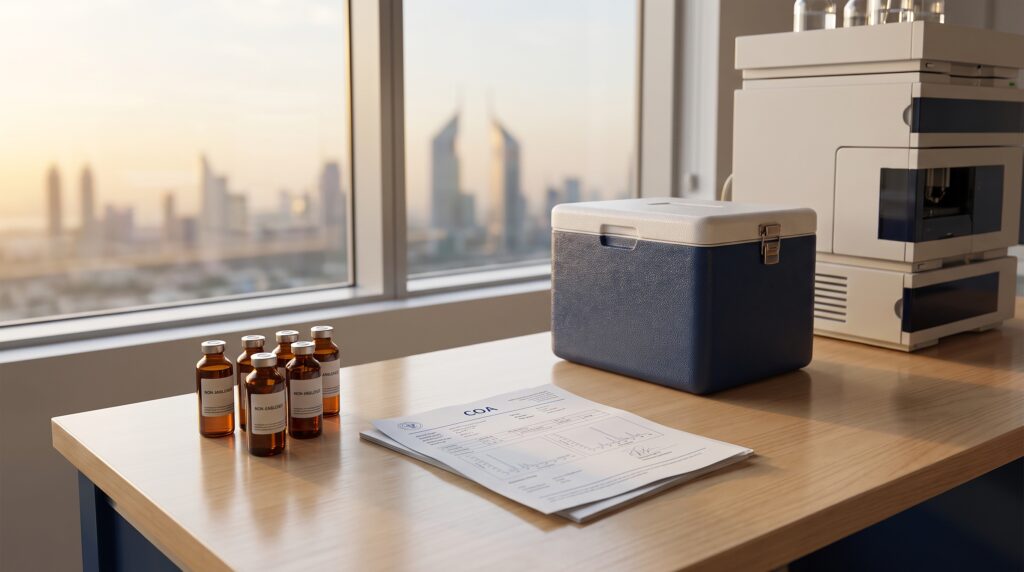
The UAE serves as a critical cold-chain transit hub before final delivery into Saudi Arabia. Suppliers leveraging advanced UAE logistics networks often bypass traditional delays, ensuring that temperature-sensitive packages are handled with precision before they cross the Saudi border. When evaluating a supplier for Saudi Arabia, ask about their GCC routing. Vendors utilizing Dubai as a localized fulfillment or specialized transit hub generally offer faster clearance times, superior tracking, and localized customer support (often via WhatsApp) compared to those shipping blindly from overseas.
Buyer Checklist: Core Checks for Peptide Purity
Before engaging an HPLC tested peptides supplier in Saudi Arabia, ensure they meet the following baseline requirements. Missing any of these elements is a critical red flag for procurement staff.
- Batch-Specific Documentation: The Certificate of Analysis (COA) must clearly display a batch number that perfectly matches the physical vial you receive. Generic, undated COAs are invalid.
- Visual HPLC Chromatogram: The supplier must provide the actual visual graph of the HPLC results. A typed “99% purity” claim on a branded letterhead is insufficient.
- High-Accuracy Mass Spectrometry: Identity reports (LC-MS/MS) should demonstrate precision within 5 parts per million (ppm), proving the exact amino acid sequence is correct.
- ISO 17025 Accreditation: Testing must be verified by a laboratory carrying internationally recognized accreditation, ensuring their analytical equipment is calibrated and unbiased.
- Residual Solvent Panels: Ensure the COA explicitly tests for toxic manufacturing solvents like TFA, acetonitrile, and DMF.
- Endotoxin Reporting: For sensitive in vitro applications, endotoxins must be quantified in EU/mg rather than vague pass/fail metrics.
The Analytical Blueprint: How to Read and Audit a Peptide COA
Many low-trust vendors use doctored, generic, or outdated paperwork to sell substandard materials. To confidently verify research materials, GCC buyers must know how to critically read a Certificate of Analysis.
Analysing the HPLC Chromatogram
High-Performance Liquid Chromatography (HPLC) separates the components of a sample to measure purity. The mobile phase pushes the peptide through a stationary phase column, separating impurities based on their chemical properties.
When viewing the visual graph (chromatogram), look for a single, sharp, distinct peak. This primary peak represents your target peptide. Red flags include elevated, noisy baselines or multiple secondary peaks—often referred to as ‘shoulders’ on the main peak. These shoulders indicate the presence of truncated sequences, degraded peptide fragments, or unresolved manufacturing impurities that will corrupt your experimental data.
The Importance of Mass Spectrometry Tolerance
While HPLC confirms how pure a sample is, Mass Spectrometry (MS) confirms the identity of the molecule by measuring its exact mass-to-charge ratio. High-accuracy LC-MS/MS reports are absolutely critical.
Look for mass precision within 5 ppm. A loose +/-0.1% tolerance is a massive red flag in peptide synthesis. For example, on a 3,000 Dalton (Da) peptide, a 0.1% tolerance allows a variance of +/- 3 Da. This seemingly small margin can easily mask wrong amino acid substitutions or missing molecular chains, fundamentally altering the peptide’s behavior and rendering research outcomes invalid.
Testing for Residual Solvents and Endotoxins
The peptide synthesis process utilizes harsh chemical reagents, such as Trifluoroacetic acid (TFA) and N,N-Dimethylformamide (DMF). If these are not properly cleaved and washed during the final stages of manufacturing, they will remain in the lyophilised cake. TFA is highly cytotoxic and will actively destroy cell cultures in in vitro studies. A comprehensive COA will include a residual solvent panel proving these toxins have been purged.
Additionally, check for endotoxin testing. Endotoxins are lipopolysaccharides found in the cell walls of certain bacteria. If introduced into a research environment, they can cause severe unintended immune responses in organic models. For an example of transparent, batch-specific analytical documentation, researchers can view our lab results to see exactly how properly structured HPLC and MS data should be presented.
Surviving the GCC Heat: Logistics, Cold-Chain, and Storage
Even the highest purity peptide is useless if it degrades during transit. Finding a reliable supplier means evaluating their logistical infrastructure just as heavily as their laboratory data. Saudi Arabia’s extreme summer temperatures in Riyadh, Jeddah, and Dammam pose a severe threat to peptide stability.
The Role of Lyophilization
Peptides must be shipped in a lyophilised (freeze-dried) state. In this form, the water has been completely removed under vacuum, leaving a stable, solid powder (or ‘puck’). Lyophilised peptides are significantly more resistant to the extreme heat fluctuations common in GCC logistics hubs.
Transit and Customs Protocols
Premium suppliers will still utilize cold-chain handling, insulated temperature-stable packaging, and strategic routing via UAE hubs to ensure the internal environment of the parcel remains stable during customs clearance delays. The Zakat, Tax and Customs Authority (ZATCA) and the Saudi Food and Drug Authority (SFDA) actively monitor chemical imports. Reputable suppliers provide the exact harmonized system (HS) codes and commercial invoices required to prove the chemical identity and safety of the research materials, preventing border confiscations.
Laboratory Handling
Once the materials arrive at your Saudi facility, inspect the vials. The vacuum seal should be intact. Vials must be immediately stored in a freezer (ideally -20°C or colder), protected from direct UV light and ambient moisture. Only reconstitute the required amount using bacteriostatic water or sterile laboratory saline immediately prior to your experimental protocol.
Evaluating Payment and Localised Support
When comparing suppliers for your laboratory, look for clear signals of operational expertise and commercial trustworthiness tailored to the Middle East:
- Responsive Local Support: Dedicated communication channels, such as WhatsApp support operating in GCC time zones, allow for real-time tracking updates and rapid resolution of clearance queries.
- Secure Payment Gateways: Reliable vendors offer transparent, secure payment methods tailored to regional needs, including encrypted credit card processing or secure cryptocurrency gateways, ensuring financial privacy for institutional buyers.
- Transparent COA Access: You should not have to beg for batch-specific testing data. It should be readily available via QR code or provided immediately upon request.
If you are ready to source high-purity, extensively documented materials for your next project, you can explore our research shop to view available compounds meticulously tailored and packaged for the GCC research sector.
Conclusion
Verifying the quality of research materials in Saudi Arabia requires vigilance. By insisting on batch-specific COAs, scrutinizing visual HPLC chromatograms, and demanding high-accuracy LC-MS/MS data, procurement teams can effectively filter out substandard vendors. When searching for HPLC tested peptides, prioritize suppliers who combine ISO-level analytical transparency with rugged, climate-aware GCC logistics—often leveraging UAE transit networks for maximum reliability. This rigorous approach ensures your laboratory research remains precise, reproducible, and compliant with all regional standards.
Disclaimer: The products and compounds mentioned in this article are strictly for laboratory research and analytical purposes only. They are not intended for human consumption, therapeutic use, or medical treatment.
References
- Saudi Food and Drug Authority (SFDA). Guidelines on the Quality Requirements of Synthetic Peptides and Investigational Materials.
- Zakat, Tax and Customs Authority (ZATCA). Import Regulations and Clearance Protocols for Laboratory Chemicals.
- UAE Ministry of Health and Prevention (MoHAP). Cold Chain Guidelines for Pharmaceutical & Research Transit.
- Saudi Accreditation Center (SAAC). ISO/IEC 17025 standards and chemical testing guidelines.
- International Organization for Standardization (ISO). ISO/IEC 17025:2017 General requirements for the competence of testing and calibration laboratories.
Disclaimer: The products mentioned in this article are for research purposes only and are not intended for human consumption.
- Research Peptides Riyadh — Regena Peptides Costa del Sol
- Peptide Certificates of Analysis: How to Read and Verify a COA (2026 Guide) | Peptidepedia
- Guideline on the Quality Requirements of Synthetic Peptides
- Peptide Supplier for Saudi Arabia | B2B Research Peptide Supply – BT BioLabs
- About Us – Alpha lab
- Testing and consulting services in Saudi Arabia and the Middle East – AGQ Labs Saudi Arabia
Frequently asked questions
Where can I find an HPLC tested peptides supplier in Saudi Arabia?
Researchers can source HPLC tested peptides from specialized scientific suppliers who provide GCC-compliant shipping via UAE cold-chain hubs and supply full, batch-specific analytical documentation verified by ISO-accredited labs.
What is the difference between HPLC and Mass Spectrometry on a peptide COA?
HPLC separates the components of a sample to measure the total purity percentage of the peptide, while Mass Spectrometry (MS) verifies the exact molecular weight and identity of the compound to ensure no amino acids are missing or substituted.
How do extreme temperatures in Saudi Arabia affect peptide delivery?
Liquid peptides degrade rapidly in extreme heat. To maintain molecular integrity during GCC transit, research peptides must be shipped in a lyophilised (freeze-dried) state using temperature-stable cold-chain packaging, often routed through specialized hubs in Dubai.
Why is an ISO 17025 accredited laboratory important for peptide testing?
ISO 17025 is the international standard for testing laboratories. Choosing a supplier that uses an accredited facility ensures that the analytical methods verifying the peptide's purity, identity, and solvent removal are scientifically sound, accurate, and reproducible.
What residual solvents should be checked on a peptide test report?
A thorough COA should prove the complete removal of toxic manufacturing solvents utilized during chemical synthesis, such as Trifluoroacetic acid (TFA), N,N-Dimethylformamide (DMF), and acetonitrile, as these can corrupt in vitro research data.
Nova Labs buyer tools
Ready to verify stock, testing and delivery?
Use the product page and lab report section to check availability, documentation, delivery timing and support before placing an order.
- COA / test-report checks
- Saudi Arabia delivery context
- Cold-chain handling
- COD and card payment options
- WhatsApp support