
Understanding GHRH and GHRP: The Biochemical Baseline
Understanding GHRH and GHRP requires recognizing their distinct cellular pathways. GHRH directly stimulates the pituitary gland to produce hormone pulses. Conversely, GHRP mimics ghrelin to release stored hormones while suppressing somatostatin, the body’s inhibitory hormone. Together, they create a highly synergistic research protocol for laboratory settings.
Key Takeaways for UAE Researchers
- Distinct Mechanisms: GHRH acts as a primary stimulator via cAMP pathways, while GHRPs act as ghrelin mimetics and potent somatostatin inhibitors.
- Synergistic Application: Co-administering both classes in vitro or in animal models produces an amplified “push-pull” biological response rather than a merely additive one.
- UAE Logistics: Procurement in the GCC requires rigorous cold-chain integrity to prevent amino acid degradation in high summer temperatures.
- Quality Verification: Never procure research peptides without a verifiable, batch-specific Janoshik HPLC Certificate of Analysis (COA).
While both classes fall under the broader umbrella of growth hormone secretagogues, their application in research demands a nuanced understanding of their individual mechanics. GHRH is considered a primary stimulator, but its efficacy is highly dependent on a test subject’s metabolic baseline. For instance, in vivo studies in animal models show that elevated abdominal visceral fat (AVF) can severely blunt the standalone effectiveness of a GHRH compound.
On the other hand, GHRP variants function as highly robust, independent stimulators. Because they bypass the standard somatotroph pathways and act on the GHS-R1a ghrelin receptor, they can reliably trigger secretion regardless of certain metabolic inhibitors that would otherwise suppress GHRH activity.
Deep Dive: The Mechanism of GHRH Peptides
To fully grasp the role of Growth Hormone-Releasing Hormone (GHRH), one must examine its structural and functional characteristics in a laboratory environment. Endogenous GHRH is a 44-amino acid peptide naturally secreted by the hypothalamus. Synthetic research analogs—most notably CJC-1295 (Modified GRF 1-29) and Tesamorelin—are truncated or modified versions designed to extend the biological half-life and prevent rapid enzymatic degradation by Dipeptidyl Peptidase-4 (DPP-4).
When a GHRH analog binds to the GHRH receptor, it activates the adenylyl cyclase enzyme. This activation leads to a surge in cyclic adenosine monophosphate (cAMP), which acts as a secondary messenger. The cAMP pathway directly promotes the transcription of genes responsible for hormone synthesis.
However, GHRH relies entirely on the natural pulsatile rhythm of the pituitary gland. It does not force an unnatural, continuous bleed of hormones; rather, it amplifies the amplitude of the pulses that are already biologically scheduled to occur. This makes GHRH variants highly physiological in their action, though their “ceiling” of efficacy is limited by the body’s internal feedback loops.
Deep Dive: The Mechanism of GHRP Peptides
Growth Hormone-Releasing Peptides (GHRPs) represent an entirely different structural family. They are synthetic, non-natural met-enkephalin analogs originally developed decades ago to act as ghrelin mimetics. Notable compounds in this category include Ipamorelin, GHRP-2, and GHRP-6, each with varying degrees of receptor selectivity and secondary effects.
Instead of acting through cAMP, GHRPs bind to the Growth Hormone Secretagogue Receptor 1a (GHS-R1a). This binding triggers a phospholipase C signaling cascade that results in a massive influx of intracellular calcium. This sudden spike in calcium forces the immediate exocytosis (release) of stored hormone vesicles.
Crucially, GHRPs also act as potent inhibitors of somatostatin. Somatostatin is the biochemical “brake” that halts hormone release. By blocking somatostatin, GHRPs ensure that the pituitary is exceptionally receptive to any secretory signals, whether they originate naturally or are introduced via a GHRH. Different GHRPs exhibit distinct characteristics in research; for example, GHRP-6 is known for triggering intense ghrelin-induced hunger in models, whereas Ipamorelin is highly selective and avoids stimulating cortisol or prolactin release.
The “Push-Pull” Synergy: Why Single-Pathway Monotherapy Has Limits
For advanced researchers, understanding GHRH and GHRP inevitably leads to the concept of co-administration. Utilizing these two classes together produces what is documented in biomedical literature as a “push-pull” synergistic effect. Data indicates that administering a GHRH alongside a GHRP results in a biological response that is exponentially more potent than utilizing either class as a standalone monotherapy.
To use an analogy common in molecular biology: GHRH acts as the accelerator, pushing the gland to synthesize and release larger pulses. However, without addressing the biological brake (somatostatin), the accelerator’s impact is heavily capped. The GHRP removes this brake while simultaneously amplifying the pulse via a secondary calcium-induced pathway.
This complementary mechanism is why the vast majority of modern laboratory protocols evaluate compounds like CJC-1295 (a GHRH) concurrently with Ipamorelin (a GHRP). The combined application maximizes receptor engagement and produces a highly predictable, robust biological response in test models.
UAE Market Realities: Navigating Clinic Pricing and Grey Markets
For procurement staff and independent bio-researchers in Dubai, Abu Dhabi, and the wider GCC, sourcing high-purity secretagogues involves navigating an opaque and often expensive local market. Historically, compounding and wellness clinics located in premium districts have dominated local supply, offering peptide packages at premium markups—frequently ranging from AED 1,300 up to AED 2,150 per protocol.
While these clinics provide a localized service, they often fail the transparency test. A critical issue for researchers is that these local entities rarely supply independent, verifiable batch-specific High-Performance Liquid Chromatography (HPLC) tests directly to the buyer. Instead, buyers receive generic pharmacy labels without the raw analytical data required to confirm exact purity percentages or mass spectrometry profiles.
Furthermore, the introduction of the UAE’s Federal Decree-Law No. 38 of 2024 established the Emirates Drug Establishment (EDE) as the supreme centralized authority responsible for the regulation of biopharmaceuticals. Importing unverified, grey-market research chemicals internationally now carries a high risk of customs friction at DXB, seizure, or severe transit delays. This regulatory reality makes it essential to partner with established local suppliers who maintain domestic inventory.
Verifying Quality: The Necessity of Third-Party HPLC COAs
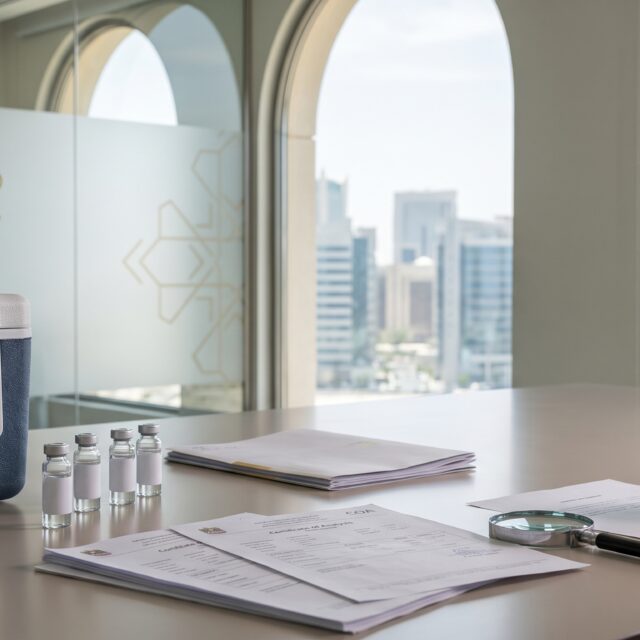
When standardizing a research protocol, the input material is the most critical variable. Procurement decisions should never rely on marketing claims or aesthetically pleasing clinic packaging. Quality verification for peptides purchased in the GCC must rely exclusively on verifiable third-party Certificates of Analysis (COA).
Independent laboratories, with Janoshik Analytical being the globally recognized standard in the peptide sector, provide unbiased verification of purity and identity. A valid COA should display an exact purity percentage (typically >98% for research grade) and a mass spectrometry chart that matches the molecular weight of the specified secretagogue.
To prevent document forgery, legitimate Janoshik COAs feature a unique verification key. Researchers can visit the Janoshik website, input the task key, and confirm that the document matches the laboratory’s internal records. The COA must also match the exact batch number printed on the vial you are holding. Transparency is paramount, empowering you to validate the integrity of your research materials before any in vitro or in vivo work commences.
Cold-Chain Integrity: Storing Peptides in UAE Summer Conditions
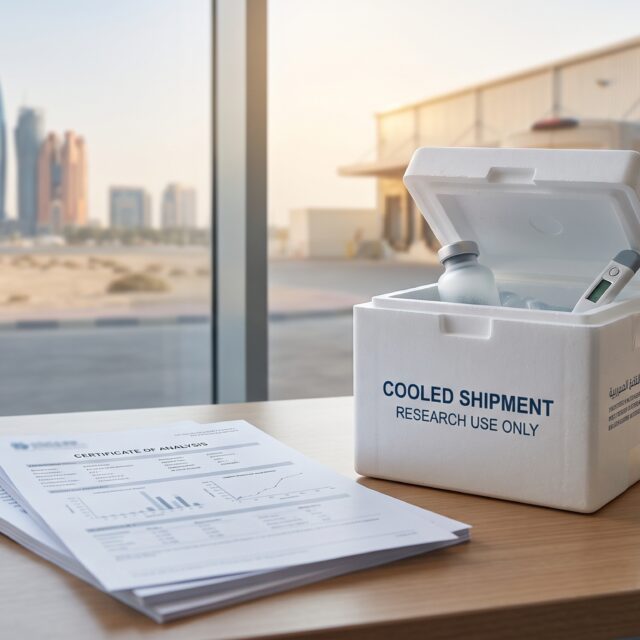
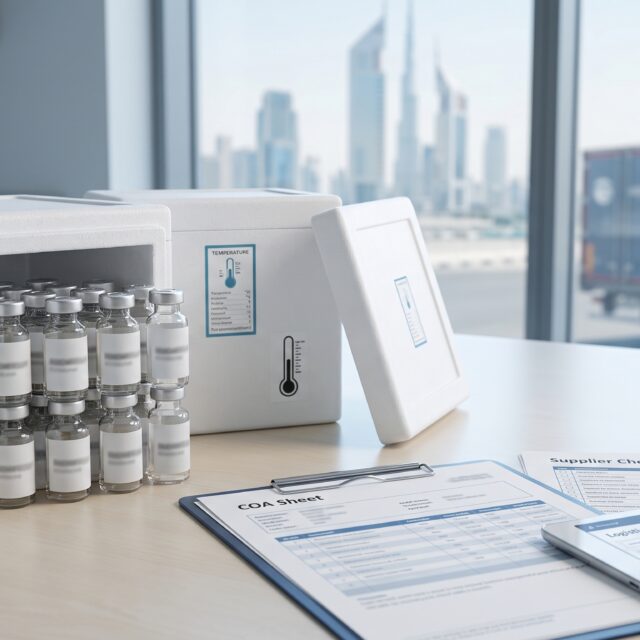
The harsh realities of the Gulf climate make sophisticated cold-chain logistics a non-negotiable factor in peptide procurement. Both GHRH and GHRP compounds are highly sensitive to heat, UV exposure, and mechanical degradation.
When maintained in their lyophilized (freeze-dried) powder state, these peptides should be stored strictly between 2°C to 8°C for short-term viability, and at -20°C for long-term archiving. Prolonged exposure to the extreme temperatures of a Dubai summer—such as sitting on a hot tarmac at a customs facility—can rapidly denature the delicate amino acid chains, rendering the research compound biochemically inactive.
Proper procurement demands localized dispatch with thermal management. Shipping internationally introduces broken cold chains and uncontrolled facility storage. By utilizing optimized UAE next-day delivery protocols, researchers can ensure that lyophilized peptides remain thermally stable from a climate-controlled facility directly to the laboratory bench.
Handling and Reconstitution Protocols
Once a high-purity GHRH or GHRP is successfully procured and delivered, proper handling remains paramount to preserving its efficacy. Lyophilized peptides must be reconstituted using sterile Bacteriostatic Water or sterile saline, depending on the specific duration of the research application.
During reconstitution, researchers must allow the vacuum inside the vial to draw the diluent in naturally, or inject it slowly down the inner glass wall. One must never forcefully inject water directly onto the powder puck, as shear stress can damage the molecular structure. Furthermore, the vial should never be vigorously shaken. Gentle swirling allows the powder to dissolve uniformly without severing the fragile peptide bonds.
Sourcing Peptides in the GCC: A Procurement Checklist
Evaluating a supplier for growth hormone secretagogues requires strict adherence to operational excellence. Researchers and buyers in the GCC should utilize the following checklist before finalizing any procurement decision:
- Third-Party Testing Verification: Are batch-specific HPLC and Mass Spectrometry reports from reputable labs like Janoshik visible, and can they be independently verified on the testing facility’s website using a task key?
- Local GCC Dispatch: Does the supplier ship locally from within the UAE, or are you risking unpredictable international customs delays and dangerous heat exposure?
- Payment and Local Support: Do they offer secure, flexible payment methods including Cash on Delivery (COD), alongside accessible localized support such as WhatsApp for rapid issue resolution?
- Stock Availability: Are the specific GHRH and GHRP variants physically in stock domestically for immediate next-day dispatch, or is it a dropshipping operation masking as a local entity?
If you are planning your next laboratory study and require uncompromising quality, explore our fully vetted research peptide catalog to access documented, high-purity compounds supported by robust local UAE logistics.
Conclusion
Mastering the research applications of these compounds begins with clearly understanding GHRH and GHRP as distinct yet highly complementary mechanisms. By leveraging their synergistic “push-pull” pathways, researchers can maximize cellular engagement and observe profound biological responses in their models.
For UAE-based buyers, this scientific understanding must be paired with rigorous procurement standards. By insisting on verifiable Janoshik COAs, acknowledging the regulatory shifts driven by the EDE, and demanding strict localized cold-chain logistics, researchers can bypass inflated clinic pricing and secure reliable materials. Quality research demands quality inputs, and verifying those inputs remains the ultimate responsibility of the informed buyer.
Disclaimer: All products mentioned in this article are strictly for laboratory research purposes only and are not intended for human consumption, diagnostic, or therapeutic use.
References
- “The UAE’s new pharmaceutical law: 10 things businesses should know.” (2024). EDE Regulatory Updates, UAE Ministry of Health.
- “Understanding GHRH and GHRP: Key Differences in Growth Hormone Regulation.” (2023). HITx Research Publications.
- “What is the difference between GH, GHRH, and GHRP.” (2022). Medical Health Institute Clinical Archive.
- “GHRP vs. GHRH: What’s the Difference and Why They Work Better Together.” (2021). Clinical Peptide Society Reviews.
- “GH-Releasing Peptides Compared: GHRP vs GHRH Research Guide.” (2023). Peptide Research Journals.
- Understanding GHRH and GHRP: Key Differences in Growth Hormone Regulation – HITx
- The UAE’s new pharmaceutical law: 10 things businesses should know
- What is the difference between GH, GHRH, and GHRP – Medical Health Institute
- GHRP vs. GHRH: What’s the Difference and Why They Work Better Together
- Peptides : r/dubai – Reddit
- GH-Releasing Peptides Compared: GHRP vs GHRH Research Guide (UK 2026)
Frequently asked questions
What is the primary difference when understanding GHRH and GHRP?
GHRH directly stimulates the pituitary to produce hormone pulses via the cAMP pathway. GHRP works indirectly by mimicking ghrelin and suppressing somatostatin, effectively removing the biological brake on hormone release in test subjects.
Do compounding clinics in Dubai provide HPLC COAs for research peptides?
Many wellness clinics in Dubai and Abu Dhabi charge premium prices, but often supply generic pharmacy labels without the raw analytical data or third-party HPLC COAs required to verify precise chemical purity.
How should lyophilized GHRH and GHRP peptides be stored in the UAE?
Unreconstituted lyophilized powder must be stored between 2°C to 8°C. Due to the extreme UAE heat, researchers must ensure their supplier utilizes localized cold-chain logistics to prevent rapid peptide degradation during transit.
How does the UAE Federal Decree-Law No. 38 of 2024 affect peptide sourcing?
This regulatory framework established the Emirates Drug Establishment (EDE) to centralize biopharmaceutical regulations. For UAE researchers, it underscores the necessity of sourcing from domestic suppliers to avoid international customs friction.
Why are GHRH and GHRP often used together in research protocols?
Co-administering these peptides creates a synergistic "push-pull" effect. GHRH accelerates hormone synthesis, while GHRP suppresses the inhibitory somatostatin, resulting in a significantly amplified biological response during laboratory studies.
Nova Labs buyer tools
Ready to verify stock, testing and delivery?
Use the product page and lab report section to check availability, documentation, delivery timing and support before placing an order.
- COA / test-report checks
- UAE delivery context
- Cold-chain handling
- COD and card payment options
- WhatsApp support