

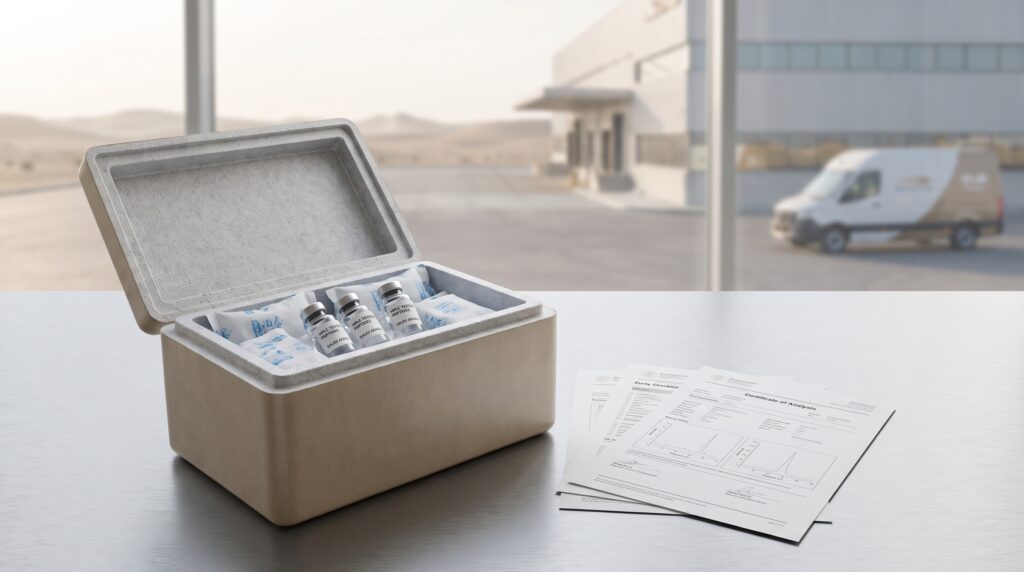
Procuring synthetic peptides for research in the GCC requires a rigorous approach to quality control. The regional landscape demands heightened scrutiny, not only due to strict regulatory frameworks but also because environmental factors like extreme heat can compromise fragile chemical compounds. For investigators and procurement staff seeking HPLC tested peptides Saudi Arabia, verifying supplier claims through independent analytical data is the most critical step before acquiring any in-vitro research standard.
Whether your laboratory is based in Riyadh, Jeddah, or Al Khobar, relying solely on a supplier’s marketing claims is a significant operational risk. True quality verification requires understanding how to read a Certificate of Analysis (COA), differentiating between purity and molecular identity, and ensuring that cold-chain logistics protect your materials during transit.
Sourcing HPLC Tested Peptides in Saudi Arabia
When sourcing HPLC tested peptides in Saudi Arabia, researchers must verify independent Certificate of Analysis (COA) documentation. A valid COA includes high-performance liquid chromatography (HPLC) data showing at least 98% purity, paired with mass spectrometry (MS) to confirm the exact molecular identity of the compound in the vial.
Sourcing materials within a heavily regulated market means that procurement staff must adhere strictly to compliance frameworks. The Saudi Food and Drug Authority (SFDA) regulates synthetic peptides under strict guidelines, requiring detailed chemical and pharmaceutical quality documentation for any clinical applications. Because unlicensed importing of peptides for therapeutic or human use is highly restricted, reputable regional suppliers frame and provide these products strictly as in-vitro chemical reference standards. This ensures that the procurement process remains legally sound and analytically precise.
The Buyer Checklist: Decoding Purity vs. Identity
A common pitfall for procurement teams evaluating an HPLC tested peptides supplier Saudi Arabia is confusing ‘purity’ with ‘identity’. A vial could technically hold a compound that is 99% pure, but if that compound is the wrong amino acid sequence entirely, the research assay is ruined. Verifying a chemical reference standard requires two orthogonal analytical methods: HPLC and MS.
High-Performance Liquid Chromatography (HPLC)
HPLC is the industry-standard method for evaluating the purity of a lyophilised peptide. The process involves passing the sample through a specialised column where different molecules travel at varying speeds. As they exit the column, a UV detector measures their absorbance, typically at wavelengths of 214-220 nm, which correspond to the peptide bonds.
When reviewing an HPLC chromatogram, buyers should look for:
- The Main Peak: A single, sharp, distinct peak indicating the target molecule.
- Area Under the Curve (AUC): The system calculates the area of the main peptide peak relative to the total area of all UV-absorbing peaks. For research applications, a purity threshold of 98% or higher is generally required.
- Gradient and Column Details: A legitimate report will list the specific analytical conditions (e.g., mobile phases used, flow rate, column type). If these details are missing, the report may be a generic template.
Mass Spectrometry (MS)
While HPLC confirms that the vial’s contents are overwhelmingly composed of one substance, it does not tell you what that substance actually is. That is the role of Mass Spectrometry (MS).
Mass Spectrometry confirms molecular identity by measuring the observed molecular weight against the theoretical mass of the specific peptide sequence.
- Tight Tolerances: Researchers must scrutinise the MS data for tight tolerances. A discrepancy wider than 5 parts per million (ppm) between the expected theoretical mass and the observed mass is a significant red flag. Wide tolerances can hide truncated amino acid sequences (where a peptide is missing one or more amino acids), which can severely alter its binding affinity in an assay.
- Isotope Patterns: Advanced MS reports will also show isotope patterns that match the predicted formula of the target peptide.
To see examples of how rigorous, batch-specific testing documentation should look, buyers can review the lab results at NOVA Labs, which provides transparent access to independent analytical testing data.
Spotting Fake COAs and Evaluating Supplier Trust
As the demand for research peptides grows, so does the prevalence of fraudulent or misleading documentation. When reviewing an HPLC tested peptides shop Saudi Arabia, investigators must be adept at spotting counterfeit COAs.
Here are the primary red flags to watch for during your supplier evaluation:
- Missing Chromatograms: A COA that merely states “Purity: 99%” in plain text without the accompanying graphical chromatogram and mass spec chart is virtually useless. Always demand the raw graphical data.
- Mismatched Batch Numbers: The batch number printed on the physical vial you receive must perfectly match the batch number listed on the testing documentation.
- Generic Lab Templates: Some illicit suppliers photoshop their logo onto generic lab reports. Verify the independent laboratory’s credentials. An ISO 17025 accredited analytical facility is the gold standard.
- Lack of Endotoxin or Heavy Metal Testing: For sensitive in-vitro cellular assays, trace contaminants matter. A comprehensive COA will often include a Lymulus Amebocyte Lysate (LAL) test to rule out bacterial endotoxins, as well as screenings for heavy metals.
Navigating the GCC Climate: Storage and Cold-Chain Logistics
The climate in Saudi Arabia poses a unique challenge for peptide stability. During the summer months, temperatures in Riyadh and Jeddah can easily exceed 40°C. Synthetic peptides are complex chains of amino acids that can quickly degrade, denature, or hydrolyse if exposed to extreme heat or UV light.
To mitigate these risks, high-quality peptides are lyophilised (freeze-dried) into a stable powder format. However, even lyophilised powders have temperature thresholds.
When evaluating regional suppliers, it is vital to assess their logistics capabilities:
- Temperature-Controlled Transit: Does the supplier utilise insulated packaging and cold-chain protocols during the height of summer?
- Regional Fulfilment: Sourcing from regional players in the UAE or GCC drastically reduces transit times compared to international imports that may sit in customs facilities for weeks.
- Discreet and Expedited Shipping: Fast-track courier services ensure that the time spent outside of a climate-controlled environment is kept to an absolute minimum.
Upon receiving the materials, laboratory personnel should immediately store lyophilised vials in a freezer at -20°C to ensure long-term stability prior to reconstitution.
Secure Procurement with NOVA Labs
For procurement staff and researchers navigating the complexities of the GCC market, dealing with a regionally established supplier eliminates the friction of long-distance imports and unpredictable customs delays. NOVA Labs is committed to supporting the region’s scientific community by providing seamless access to meticulously tested chemical reference standards.
We understand that confidence in your research starts with confidence in your materials. By prioritising verifiable independent documentation, maintaining strict cold-chain logistics across the Middle East, and providing dedicated regional support via WhatsApp, we ensure that your procurement process is as rigorous as your research.
For investigators looking to source verified materials, you can browse our complete inventory and shop our comprehensive range of research standards.
Conclusion
Acquiring HPLC tested peptides in Saudi Arabia demands a strict adherence to quality verification and an understanding of the region’s specific logistical challenges. By mastering the distinction between HPLC purity and MS molecular identity, scrutinising batch-specific COAs, and partnering with suppliers who understand GCC climate constraints, researchers can safeguard their assays and ensure reproducible data. Always prioritise transparency, demand graphical analytical evidence, and ensure your procurement adheres to the highest standards of laboratory diligence.
*
Disclaimer: The products mentioned in this article are for in-vitro research purposes only and are not intended for human consumption or therapeutic use.
References
- Saudi Food and Drug Authority (SFDA). Guideline on the Quality Requirements of Synthetic Peptides.
- Vanguard Laboratory. The Ultimate Guide to HPLC Testing for Peptides.
- Tide Labs. How to read an HPLC chromatogram (peptides) — a quick QC guide.
- Peptidepedia. Peptide Certificates of Analysis: How to Read and Verify a COA.
- Peptide Certificates of Analysis: How to Read and Verify a COA (2026 Guide) | Peptidepedia
- How To Read A Peptide COA | Muscle And Brawn
- The Ultimate Guide to HPLC Testing for Peptides – Vanguard Laboratory
- How to read an HPLC chromatogram (peptides) — a quick QC guide – Tide Labs
- Research Peptides Riyadh — Regena Peptides Costa del Sol
- Guideline on the Quality Requirements of Synthetic Peptides – Saudi Food and Drug Authority
Frequently asked questions
What is a good HPLC purity percentage for research peptides?
For reliable in-vitro research applications, a high-performance liquid chromatography (HPLC) purity of 98% or higher is generally considered the industry standard. This ensures that minimal impurities or truncated sequences interfere with the chemical assay.
Why do peptides need Mass Spectrometry alongside HPLC?
While HPLC measures the purity of the sample, it cannot confirm what the molecule actually is. Mass Spectrometry (MS) is required to verify the molecular weight and identity of the peptide, ensuring the compound exactly matches the intended amino acid sequence.
How can I verify a peptide COA in Saudi Arabia?
To verify a Certificate of Analysis, ensure the report includes graphical HPLC and MS data, check that the batch number matches your vial exactly, and confirm the testing was conducted by an independent, ISO-accredited laboratory.
How are research peptides shipped safely in the GCC heat?
Reputable suppliers ship peptides in a lyophilised (freeze-dried) state using insulated, temperature-controlled packaging and expedited regional courier services to prevent degradation from the intense GCC climate.
What is the correct storage temperature for lyophilised peptides?
Unreconstituted, lyophilised peptide powders should be stored securely in a laboratory freezer at -20°C upon arrival. This maintains their structural stability and prolongs shelf life prior to laboratory use and reconstitution.
Nova Labs buyer tools
Ready to verify stock, testing and delivery?
Use the product page and lab report section to check availability, documentation, delivery timing and support before placing an order.
- COA / test-report checks
- Saudi Arabia delivery context
- Cold-chain handling
- COD and card payment options
- WhatsApp support