

The research peptide landscape is currently navigating a significant quality control challenge. High-profile international vendor shutdowns, an influx of unregulated grey-market suppliers, and highly sophisticated counterfeiting operations have made procurement increasingly risky. For researchers and informed buyers in the UAE and GCC, the stakes are even higher due to extreme local climate conditions and rigorous new federal customs regulations.
How to Spot Fake Peptides: The Verification Baseline
To spot fake peptides, ignore the powder’s appearance and demand independently verifiable, third-party laboratory tests. You must check the High-Performance Liquid Chromatography (HPLC) report for purity (aiming for >98%) and Mass Spectrometry (MS) for molecular identity, while ensuring the batch number matches the supplier’s live database.
Historically, buyers relied on supplier reputation or rudimentary visual checks to gauge product quality. Today, visual characteristics are entirely unreliable. Fabricators now utilise AI-generated chromatograms, stolen laboratory headers, and deceptive shipping practices to pass off underdosed or completely inert compounds as premium research materials. Protecting your research requires a strict, data-driven verification protocol.
Why the “Visual Check” is a Dangerous Myth
One of the most persistent myths in the research community is that you can determine a peptide’s authenticity by looking at the lyophilised (freeze-dried) “puck” or powder inside the vial.
Some buyers mistakenly believe that a solid, perfectly formed white disc indicates high purity, while a loose, broken powder signals degradation or a fake product. In reality, the physical structure of the peptide cake is dictated almost entirely by the excipients—specifically the type and volume of filler used, such as mannitol or glycine, as well as the specific vacuum pressure during the lyophilisation process.
A perfectly uniform puck can easily contain zero active compound, while a shattered, powdery vial might contain 99.9% pure material. Relying on visual inspection is a critical error that counterfeiters exploit. True verification happens exclusively through advanced chemical analysis.
The Golden Standard: Decoding HPLC and MS Testing
Rigorous peptide verification relies on a dual-testing protocol. A reliable supplier must provide both High-Performance Liquid Chromatography (HPLC) and Mass Spectrometry (MS) data. Understanding these two metrics is non-negotiable for serious procurement.
Mass Spectrometry (MS) for Identity
Mass Spectrometry answers one fundamental question: Is this the correct molecule? MS works by ionising the chemical species and sorting the ions based on their mass-to-charge ratio. Every peptide has a specific, mathematically known molecular weight. For example, if you are sourcing Tesamorelin for a metabolic study, the MS report must reflect its exact structural mass. If the mass is off, you have a completely different—and potentially hazardous—substance.
HPLC for Purity
While MS confirms identity, HPLC confirms purity. The HPLC chromatogram maps out the composition of the sample over time. You are looking for a single, sharp, distinct peak on the graph, indicating that the vast majority of the vial contains the target peptide.
Multiple jagged peaks or “noise” along the baseline reveal the presence of impurities, degraded peptide fragments, or heavy metal contamination. For rigorous clinical analysis, research-grade purity is universally defined as 98% or higher. Anything below this threshold should be rejected.
How Scammers Fabricate COAs (And How to Audit Them)
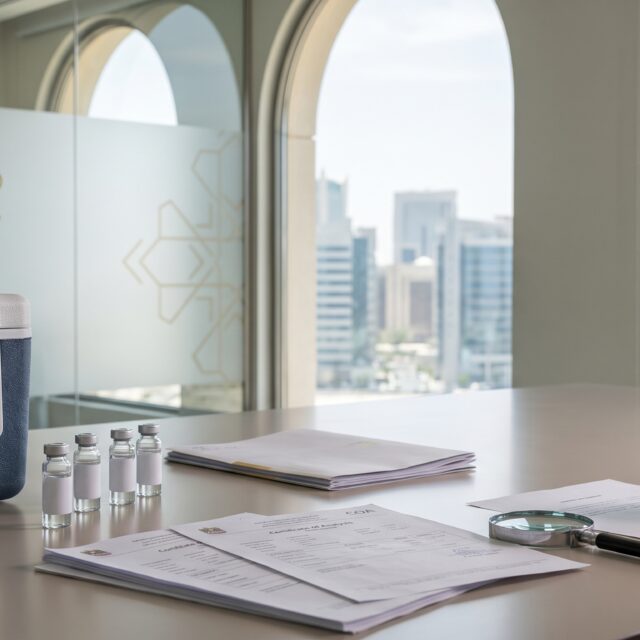
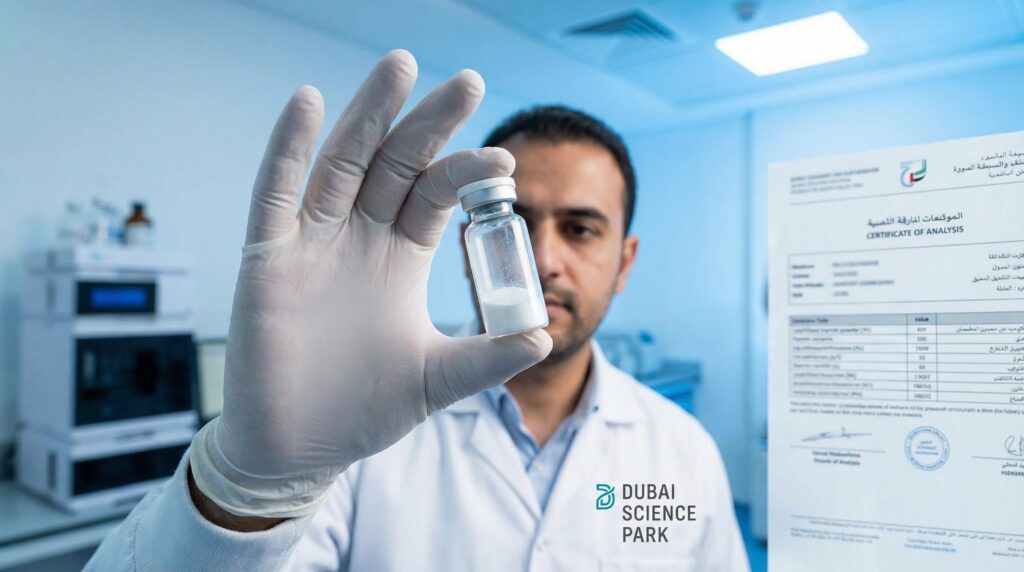
A Certificate of Analysis (COA) is only as trustworthy as the laboratory that issued it. Because buyers have become educated enough to demand COAs, scammers have adapted by producing highly convincing fakes.
Here are the most common COA fabrication tactics and how to spot them:
- AI-Generated Chromatograms: Scammers are using generative AI to produce flawless, fictional HPLC graphs.
- Stolen Headers: Disreputable vendors will download a legitimate COA from a trusted supplier, use photo-editing software to replace the company name with their own, and upload it as proof.
- The “Golden Batch” Illusion: A vendor may send one genuinely pure sample to a testing facility to earn a real COA, but then proceed to sell thousands of vials from a completely different, unverified, and inferior batch.
How to cross-verify: Never take a PDF at face value. Look for testing from reputable, independent labs such as Janoshik. Always locate the unique verification key or test ID on the COA, go directly to the testing laboratory’s official website, and enter the key into their public database. If the report does not populate, or if the batch numbers do not perfectly align with the inventory you are purchasing, the product is compromised.
UAE & GCC Sourcing Risks: Scams, Customs, and the EDE
The UAE market is highly fragmented. Because premium local providers frequently charge exorbitant rates for verified compounds, independent researchers are often driven toward unregulated grey-market imports. This environment has spawned aggressive local scams.
The Telegram and WhatsApp Escalation Scam
A prominent scam pattern targeting GCC buyers involves “local contacts” on WhatsApp or Telegram. These actors build trust by successfully delivering a small initial order. Once the buyer feels confident and places a larger bulk order using an unsecured payment method like cryptocurrency or an international bank transfer, the vendor vanishes. Sometimes, they will claim the package is “stuck in customs” and demand a secondary “release fee” before blocking the buyer entirely.
Customs Seizures and Deceptive Declarations
Under the UAE’s Federal Decree-Law No. 38 of 2024, the newly established Emirates Drug Establishment (EDE) serves as the centralised federal regulator for biopharmaceutical products. Dubai Customs has subsequently tightened its oversight.
Many overseas vendors attempt to bypass these strict checks by deceptively declaring peptide shipments as “beauty care,” “essential oils,” or “glass samples.” Dubai Customs utilises advanced spectroscopic screening; when misdeclared biological materials are identified, they are immediately seized, leaving the buyer out of pocket with no recourse.
The Climate Threat: Why Local Cold-Chain Matters
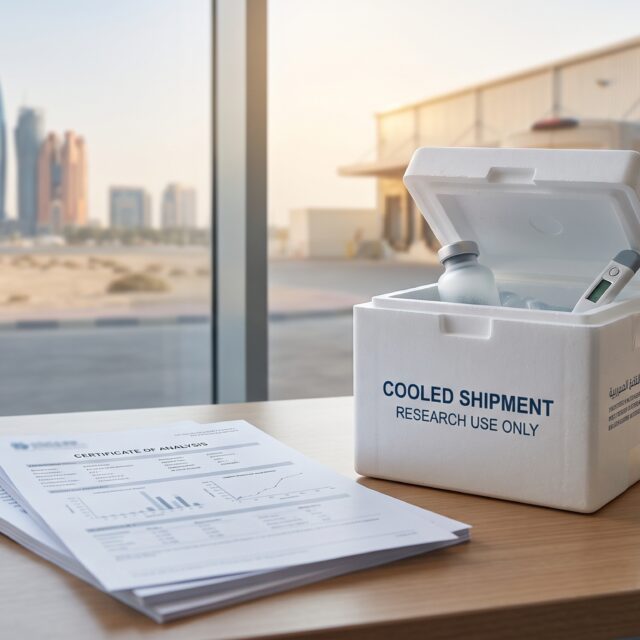
Even if an overseas supplier is entirely legitimate and ships highly pure products, the local climate poses a severe threat. Lyophilised peptides are delicate molecular structures that are highly susceptible to thermal degradation.
Standard international shipping often takes 7 to 14 days. During the UAE summer, a package sitting on a sun-baked tarmac or riding in the back of an unairconditioned final-mile delivery van can easily reach temperatures exceeding 45°C. Prolonged heat exposure causes the peptide bonds to denature, effectively rendering the expensive compound inert before it even reaches your laboratory.
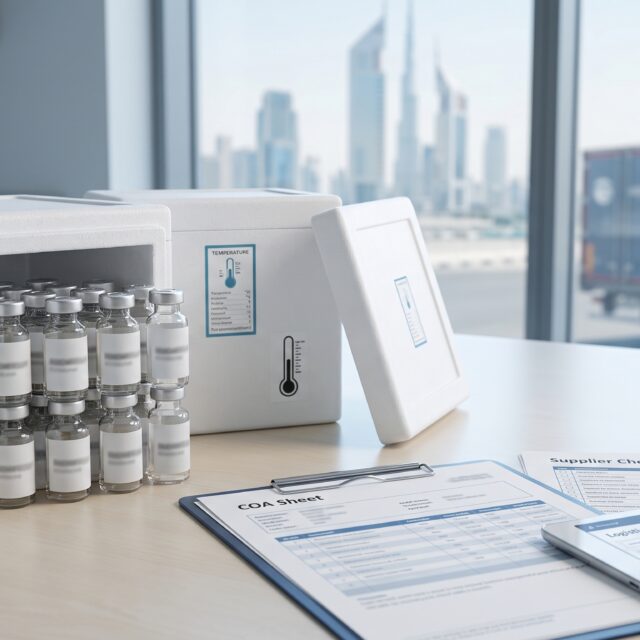
This is why local, temperature-controlled distribution is essential. NOVA Labs UAE eliminates both customs friction and thermal degradation by warehousing verified stock locally. We offer secure, cold-chain UAE next-day delivery across the Emirates. By managing the logistics locally, we ensure that the compound’s integrity is perfectly maintained from our climate-controlled facilities directly to your doorstep.
Buyer Checklist for Sourcing Authentic Peptides
Before placing an order, ensure the vendor meets the following criteria:
- Independent Verification: Can you verify the COA directly on a third-party laboratory’s database (e.g., Janoshik)?
- Complete Data: Does the COA include both HPLC (for >98% purity) and MS (for molecular identity)?
- Batch Transparency: Do the batch numbers on the vial perfectly match the batch numbers on the verified lab report?
- Local Logistics: Does the supplier offer temperature-controlled, rapid local shipping to avoid UAE heat degradation?
- Secure Payment: Do they offer secure local payment gateways, including Cash on Delivery (COD), rather than insisting on untraceable cryptocurrency transfers?
- Customer Support: Is there a verifiable, responsive local support channel that can answer specific technical questions about batch dates and COA updates?
Bottom Line
In an industry flooded with sophisticated fakes and deceptive shipping practices, hope is not a strategy. Visual inspections and vendor promises mean nothing without independent, cryptographically verifiable data. For researchers in the GCC, mitigating risk means demanding strict HPLC and MS documentation, bypassing the hazards of international customs, and ensuring rapid cold-chain delivery.
At NOVA Labs, we prioritize transparency and operational excellence. Every batch is rigorously blind-tested, and our analytical reports are fully public. If you are looking for secure local sourcing, you can browse our full catalogue of verified peptides to find the precise, high-purity compounds your research requires.
Disclaimer: The products mentioned in this article are for research purposes only and are not intended for human consumption or therapeutic use.
—
References:
- Federal Decree-Law No. 38 of 2024, The Emirates Drug Establishment (EDE) Regulatory Framework, UAE Government Publications.
- Understanding High-Performance Liquid Chromatography (HPLC), Journal of Analytical Chemistry.
- Thermal Degradation of Lyophilised Proteins and Peptides, Biopharmaceutical Cold Chain Logistics Analysis.
References
- Peptide in Dubai : r/UAE – Reddit
- Peptides : r/dubai – Reddit
- The New Era of Pharmaceutical Regulation in the UAE: Key Changes Under Federal Law No. 38 of 2024 – Al Tamimi & Company
- How to Verify a Peptide: COAs, Lab Testing & Spotting Fakes (2026)
- Peptide Vendor Scams: 8 Red Flags + COA Checklist (2026) – NorthPeptide
- Shipping Peptides to Dubai – “beauty care “ declaration got seized. What declaration worked for you recently? : r/UAE – Reddit
- Decoding the peptide craze: UAE experts explain the risky injectable wellness trend and what science says – Gulf News
- Nova-biolabs : r/UAE – Reddit
Frequently asked questions
Can you tell if a peptide is fake by looking at the powder?
No. The visual appearance of a lyophilised peptide 'puck' or powder is determined by the specific filler (like mannitol) and the vacuum pressure used during manufacturing, not the purity or authenticity of the active compound.
What is a Janoshik COA in peptide testing?
Janoshik is a highly trusted, independent third-party analytical laboratory. A Janoshik COA provides verified High-Performance Liquid Chromatography (HPLC) and Mass Spectrometry (MS) results, which can be cross-checked using a unique key on their public database.
Why do overseas peptide shipments get seized in Dubai?
Under Federal Decree-Law No. 38 of 2024, the Emirates Drug Establishment (EDE) closely monitors biopharmaceutical imports. Overseas vendors often misdeclare packages, leading to immediate confiscation by customs if biological materials lack proper institutional documentation.
Does heat damage lyophilised peptides during shipping?
Yes. Lyophilised peptides are highly vulnerable to thermal degradation. Prolonged exposure to extreme UAE summer temperatures during standard international shipping can break down the peptide bonds, rendering the compound inert before it reaches your laboratory.
Nova Labs buyer tools
Ready to verify stock, testing and delivery?
Use the product page and lab report section to check availability, documentation, delivery timing and support before placing an order.
- COA / test-report checks
- UAE delivery context
- Cold-chain handling
- COD and card payment options
- WhatsApp support