

The Essential Guide to Sourcing TB-500 in the UAE
To successfully buy TB-500 in the UAE, laboratory managers must source from domestic suppliers providing batch-specific HPLC purity testing. Purchasing locally within Dubai prevents customs seizures, ensures climate-controlled cold-chain transit, and guarantees next-day delivery to keep fragile lyophilized peptides structurally stable.
Buyer Checklist: Key Takeaways for UAE Procurement
- Verify Purity Documentation: Always demand a batch-specific Certificate of Analysis (COA) showing 99%+ purity via HPLC and MS.
- Bypass International Customs: Source from vendors with stock already cleared and warehoused in the Emirates to prevent EDE/customs seizures.
- Demand Cold-Chain Logistics: Ensure your supplier utilizes temperature-controlled packaging suitable for the GCC climate.
- Require Local Support: Prioritize suppliers offering accessible WhatsApp support and flexible payment methods like Cash on Delivery (COD).
- Strict Compliance: Adhere strictly to Research Use Only (RUO) guidelines; these compounds are strictly for in vitro laboratory analysis.
For procurement staff and bio-researchers, the local market can sometimes present a confusing landscape. Securing reliable, high-purity research materials requires navigating complex documentation standards, climate-specific logistics, and shifting regional regulations without compromising on chemical integrity. Whether you are conducting tissue repair studies or cellular migration assays involving actin binding, the quality of your supplier directly dictates the validity of your research data.
This comprehensive guide covers how to evaluate laboratory documentation, manage domestic cold-chain logistics in the Emirates, and confidently source biochemical inventory without risking degraded product or regulatory friction.
Evaluating a TB-500 Supplier in Dubai and the GCC
Not all peptides marketed online meet the stringent standards required for professional scientific analysis. Researchers must prioritize analytical transparency above standard marketing claims. A reputable TB-500 supplier operating in the GCC will always back their inventory with verifiable, third-party laboratory documentation.
Decoding HPLC and Mass Spectrometry
The benchmark for peptide purity in a professional research setting is 99% or higher. This metric is not simply a promotional term; it is a highly quantifiable standard proven through High-Performance Liquid Chromatography (HPLC) and Mass Spectrometry (MS).
HPLC separates the chemical components to ensure the TB-500 is free of synthesis by-products. When reviewing an HPLC chromatogram, procurement officers should look for a singular, sharp, well-defined peak at a specific retention time. Multiple wide or jagged peaks indicate the presence of impurities or degraded peptide fragments.
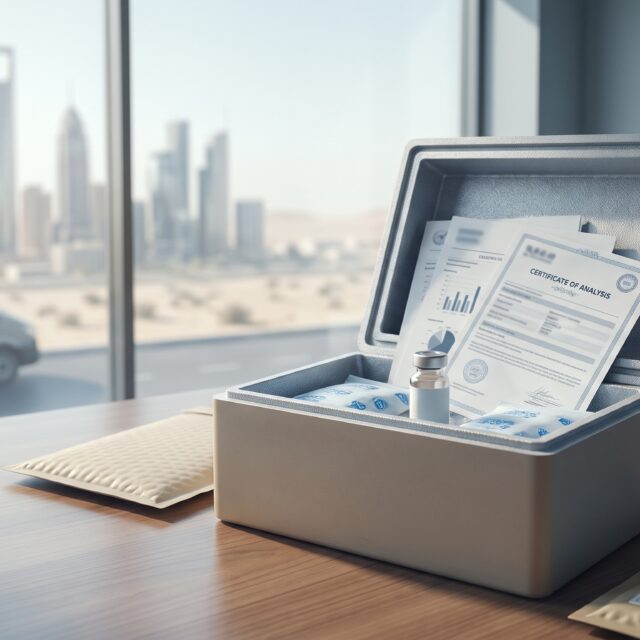
Mass Spectrometry is equally critical, as it confirms the exact molecular weight of the peptide. For TB-500 (a synthetic fraction of Thymosin Beta-4), the molecular mass must match expected theoretical values (approximately 4963.5 g/mol, depending on the exact sequence formulation). When reviewing a vendor’s Certificate of Analysis (COA), buyers should explicitly look for:
- A recent testing date that explicitly aligns with current stock batches.
- Clear, legible HPLC graphs showing a distinct primary peak indicating >99% purity.
- Third-party validation from an independent analytical facility, rather than unverified, in-house manufacturer claims.
Understanding Filler-Free Vials
One common point of confusion for new procurement staff in the UAE is the physical appearance of premium peptides. High-purity vials that are synthesized without bulk fillers—such as mannitol or lactose—may look virtually empty upon initial inspection.
The lyophilized (freeze-dried) peptide often appears as a microscopic thin film, a delicate web, or a tiny, compressed puck at the base of the glass vial. This visual profile is a hallmark of a pure, filler-free compound, not a manufacturing error or a shorted product. Researchers must use precise reconstitution protocols with sterile bacteriostatic water to properly suspend the peptide into a liquid solution for accurate laboratory pipetting and use.
Local vs. International Sourcing: Navigating UAE Customs
The regulatory environment surrounding biochemical imports in the Gulf is highly scrutinized and rigorously enforced. In 2024, the UAE enacted Federal Decree-Law No. 38, establishing the Emirates Drug Establishment (EDE) as the central regulatory authority for medical, pharmaceutical, and biopharmaceutical approvals. While human peptide therapies require stringent Dubai Health Authority (DHA) oversight in clinical settings, retail research peptides operate under strict Research Use Only (RUO) parameters.
Ordering peptides internationally from unvetted sources—such as direct-from-overseas wholesalers or generic dropshippers—poses a remarkably high risk to research continuity. Shipments frequently lack the precise commercial invoices, EDE import permits, and technical documentation required by UAE customs authorities. This routinely leads to prolonged customs holds, intense scrutiny, or outright destruction of the parcel.
By sourcing from a domestic supplier with established warehousing in the Emirates, researchers eliminate international customs friction entirely. Local vendors have already navigated the complex import documentation, ensuring that domestic fulfillment is rapid, predictable, and legally compliant within RUO boundaries.
Cold-Chain Logistics and Next-Day Delivery in the Emirates
The severe climate of the GCC presents a unique challenge for biopharmaceutical handling. Unreconstituted lyophilized peptides are highly sensitive to prolonged heat and direct UV light exposure. Extended heat exposure can rapidly degrade the fragile amino acid chains, cleaving the peptide and rendering the compound useless for precise analytical research.
International shipments that sit on hot airport tarmacs at DXB or AUH, or wait for days in unconditioned customs warehouses during the peak of the UAE summer, face severe risks of degradation. This reality makes localized cold-chain logistics non-negotiable for serious researchers.
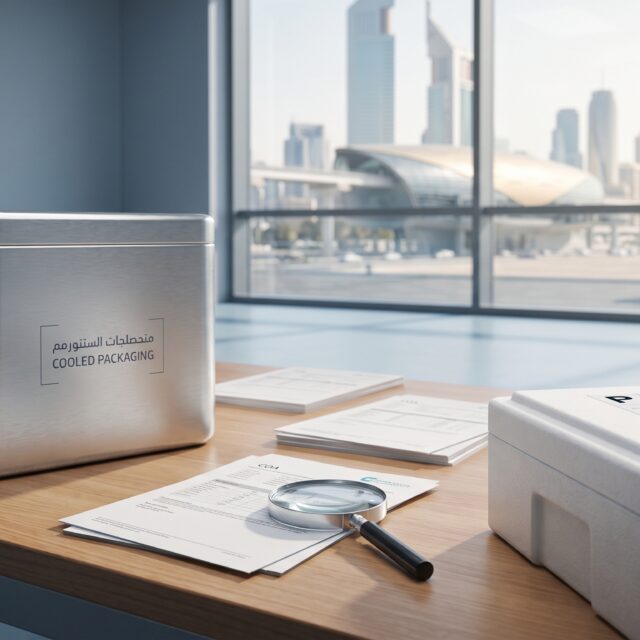
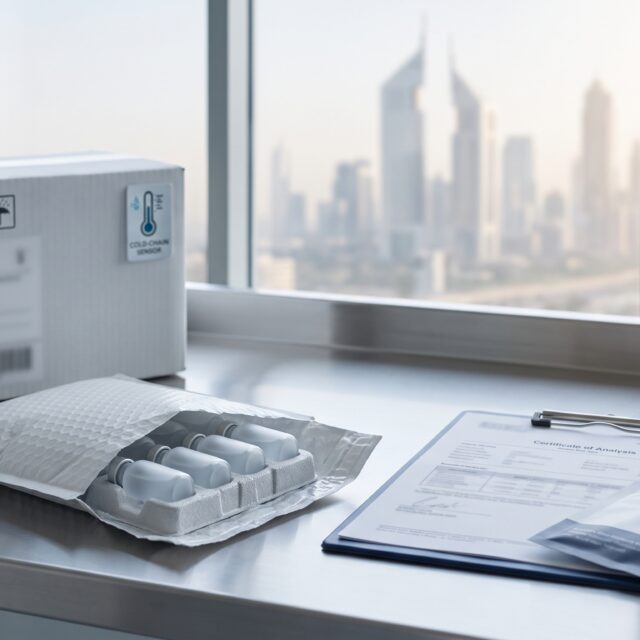
Premium local suppliers bypass these environmental risks entirely by holding stock domestically in climate-controlled facilities. For time-sensitive laboratory schedules, choosing a vendor that offers UAE next-day peptide delivery ensures the transit window is kept to an absolute minimum. Packages are dispatched in specialized protective packaging and handed over through dedicated local courier networks. This localized approach preserves the structural integrity of the peptide from the warehouse storage freezer directly to your laboratory bench.
Storage Guidelines and Research Compliance
Once TB-500 arrives at your facility, proper handling is required to maintain its 99%+ purity over the long term. Even the highest quality peptide will degrade if stored improperly.
Strict Temperature Controls
For long-term storage, unreconstituted (lyophilized) TB-500 vials must be kept at -20°C in a laboratory freezer. At this temperature, the compound remains stable and viable for up to 24 months. If immediate use is planned within a few weeks, refrigeration at 2°C to 8°C is acceptable for short periods, but sub-zero temperatures are the gold standard for preserving chemical viability.
Once reconstituted with bacteriostatic water, the dynamics change. The solution must remain refrigerated (never frozen, as freezing liquids can damage the peptide structure) and should typically be utilized within a window of 14 to 21 days before measurable degradation begins to impact assay results.
Compliance and RUO Restrictions
Researchers and procurement officers must maintain strict adherence to international and local compliance standards. Thymosin Beta-4 and its synthetic derivatives, including TB-500, are strictly prohibited at all times (both in-competition and out-of-competition) under the current World Anti-Doping Agency (WADA) Prohibited List.
Furthermore, UAE consumer laws and EDE frameworks dictate that these compounds are sold explicitly as biochemical reagents. They are strictly for in vitro studies, cellular migration assays, protein binding analysis, and related laboratory research. Reputable suppliers enforce these RUO boundaries heavily; they do not provide dosing, injection, or human treatment instructions, and will terminate accounts that imply intent for human consumption.
Research Pairing: TB-500 and BPC-157
In advanced laboratory environments, TB-500 is frequently studied alongside BPC-157. Researchers analyze these compounds together due to their complementary, non-overlapping mechanisms. While TB-500 is heavily observed for its interaction with actin and its role in cellular motility up-regulation, BPC-157 is studied for its angiogenesis and localized tissue repair properties. When procuring stock for comprehensive tissue-healing in vitro studies, ensuring both compounds share the exact same standard of HPLC-verified purity is vital for effectively controlling experimental variables.
Conclusion: Sourcing Premium Research Materials
Acquiring reliable research peptides in the Gulf does not have to involve prolonged customs delays, questionable international quality, or compromised cold-chain transit. By prioritizing local suppliers that offer complete transparency through third-party COAs, researchers can secure laboratory materials with total confidence. Focusing on local warehousing, rapid domestic delivery, robust support, and verified filler-free compounds ensures that your laboratory is equipped with the highest grade materials for accurate, reproducible results.
NOVA Labs operates specifically to serve the needs of the UAE and GCC research communities by bridging the gap between rigorous laboratory standards and localized convenience. We provide batch-specific COA and HPLC testing to guarantee our inventory meets the strict 99%+ purity threshold. With flexible payment methods including Cash on Delivery (COD) and responsive WhatsApp support, we prioritize a frictionless purchasing experience.
To review current stock levels, verify batch purity documentation, and secure premium research materials for your next project, you can order TB-500 UAE directly through our secure platform.
*
Disclaimer: The products mentioned in this article are strictly for laboratory research and analytical purposes only. They are not intended for human consumption, therapeutic use, or medical treatment.
References
- UAE Ministry of Health and Prevention (MOHAP). Federal Decree-Law No. (38) of 2024 Governing Medical Products, Pharmacists and Pharmaceutical Establishments.
- World Anti-Doping Agency (WADA). The 2024 Prohibited List.
- National Center for Biotechnology Information (NCBI). Thymosin beta-4: actin regulation and tissue repair assays.
Disclaimer: The products mentioned in this article are for research purposes only and are not intended for human consumption.
- Federal Decree-Law No. (38) of 2024 Governing Medical Products, Pharmacists and Pharmaceutical Establishments
- WADA’s 2026 Prohibited List is now in force | World Anti Doping Agency
- Peptide Therapy in Dubai & Abu Dhabi | DNA Health and Wellness
- Peptides : r/dubai – Reddit
- FAQ – Answers About Peptides & Dn Research
- BPC-157 vs TB-500: evidence, approval and risks | Peptide Guide UAE
- UAE customs? : r/PeptidePathways – Reddit
- Buy BPC 5mg + TB 5mg UAE For Lab Research
Frequently asked questions
Is it legal to buy TB-500 in the UAE?
Yes, it is legal to purchase TB-500 in the UAE provided it is strictly for in vitro laboratory research and biochemical analysis. It must not be purchased, sold, or marketed for human consumption, medical treatment, or self-administration.
Why does my lyophilized TB-500 vial look almost empty?
Premium research peptides synthesized without bulk fillers like mannitol or lactose often appear as a microscopic thin film or a tiny puck at the bottom of the vial. This visual profile is a normal indicator of a highly pure, filler-free product.
How should TB-500 be stored to prevent degradation in Dubai?
Unreconstituted (lyophilized) TB-500 should be stored in a laboratory freezer at -20°C for long-term stability. Once the peptide is reconstituted with bacteriostatic water, it must be kept refrigerated at 2°C to 8°C away from direct UV light.
Can I import TB-500 from international suppliers into the UAE?
While technically possible, importing peptides directly from unvetted overseas suppliers carries a high risk of customs seizure due to strict UAE import documentation requirements under the Emirates Drug Establishment (EDE). Sourcing locally bypasses these delays.
How can I verify the purity of my TB-500 supplier in the GCC?
Buyers should demand a batch-specific Certificate of Analysis (COA) that includes recent High-Performance Liquid Chromatography (HPLC) and Mass Spectrometry (MS) documentation proving a purity level of 99% or higher.
Nova Labs buyer tools
Ready to verify stock, testing and delivery?
Use the product page and lab report section to check availability, documentation, delivery timing and support before placing an order.
- COA / test-report checks
- UAE delivery context
- Cold-chain handling
- COD and card payment options
- WhatsApp support